When to Prune Crepe Myrtles in NC at a Glance
The best time to prune crepe myrtles in North Carolina is late February to early March, while the trees are dormant and just before spring growth starts. Crepe myrtles bloom on new wood, so pruning at that time costs you no summer flowers. Topping them back to bare trunks, often called crape murder, leaves weak shoots, knobby knuckles and a tree that is more prone to storm breakage and bark scale. Good pruning removes suckers, crossing branches, dead wood and twigs no thicker than a pencil, and it never cuts the main trunks down to stubs.
Every February, the same scene plays out on streets all over Raleigh. Crepe myrtles that looked graceful the summer before are cut back to bare, thick stumps, and by June they are covered in a thicket of thin shoots that flop over under the weight of their own flowers. Most homeowners who do this are trying to take good care of their trees. The problem is that the timing is usually right and the method is wrong.
Our crews prune crepe myrtles across Raleigh, Cary, Apex and Wake Forest every winter, and we see the long-term results of both approaches. Trees that are pruned lightly and on time keep their smooth, peeling bark, flower heavily and stand up to summer thunderstorms. Trees that are topped year after year turn knobby, weak and harder to care for with every season. Getting the timing and the technique right is what keeps a crepe myrtle healthy for decades.
When to Prune Crepe Myrtles in NC: Late February to Early March
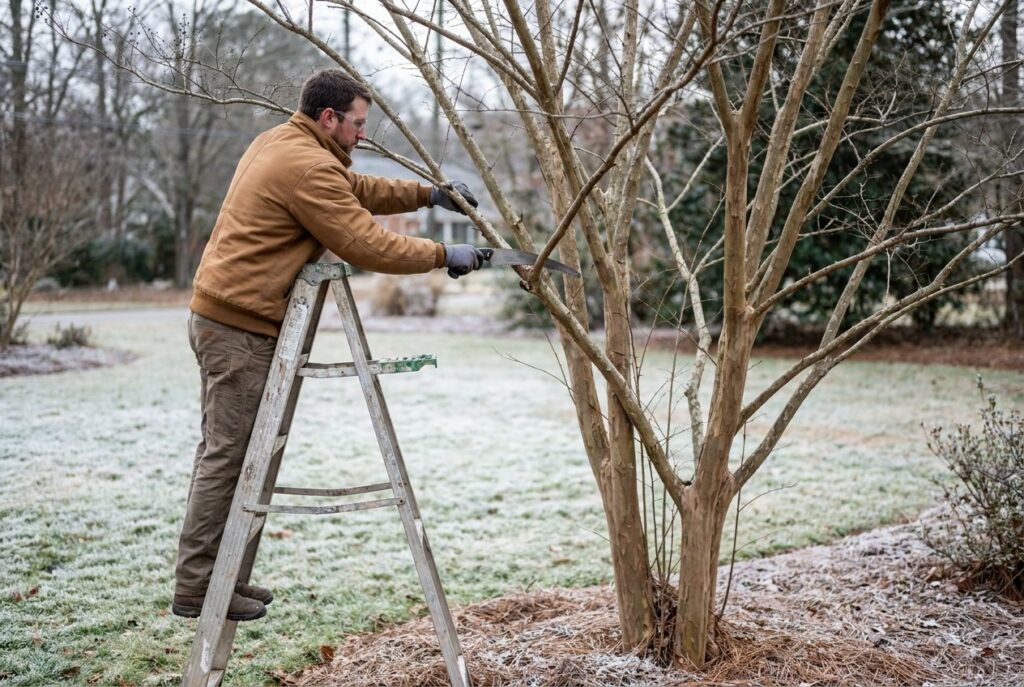
The best time to prune crepe myrtles in NC is late February into early March, while the tree is still dormant and before new leaves begin to push out. NC State Extension gives the same window and recommends keeping three to five of the strongest trunks on multi-stem trees (NC State Extension). With the leaves off, every branch is easy to see, so it is simple to spot crossing limbs, inward growth and dead wood. The tree then puts its spring energy straight into healing those cuts and growing the new wood that will carry this summer’s flowers.
In Raleigh and most of Wake County, that window usually runs from mid-February to around the middle of March, depending on how early spring arrives. A mild winter can bring buds out a little sooner, so it pays to finish structural work before the branch tips start to swell and turn red. Light jobs such as removing suckers or broken branches can be done at almost any time of year. The heavier pruning cuts belong in that late-winter window.
| Time of Year | Crepe Myrtle Pruning in Raleigh | Why |
|---|---|---|
| Late February to early March | Main structural pruning, thinning and crossing branches | Dormant tree, clear view of branches, fast healing in spring |
| Spring | Remove any branches that did not leaf out | Dead wood is easy to spot once the rest of the tree is green |
| Early to mid summer | Cut spent flower clusters within reach | Can encourage a smaller second flush of blooms |
| Summer | Remove suckers at the base as they appear | Keeps energy in the main trunks |
| Late summer and fall | Avoid heavy pruning | New growth may not harden off before the first freeze |
| November to January | Avoid major pruning | Cuts sit open through the coldest months |
Our month-by-month tree trimming calendar for Raleigh shows how crepe myrtle work fits alongside oaks, maples and the rest of the trees on your property. If you have several types of trees in the yard, a single late-winter visit can often handle all of them together. That keeps the cost down and means only one cleanup.
Not Sure When Your Crepe Myrtles Should Be Pruned?
Our certified arborist will look at each tree with you, explain exactly what needs to come off and give you a clear written price. Every estimate is free, and late-winter dates fill quickly in Raleigh.
Why Late Winter Is the Best Time to Prune Crepe Myrtles in Raleigh
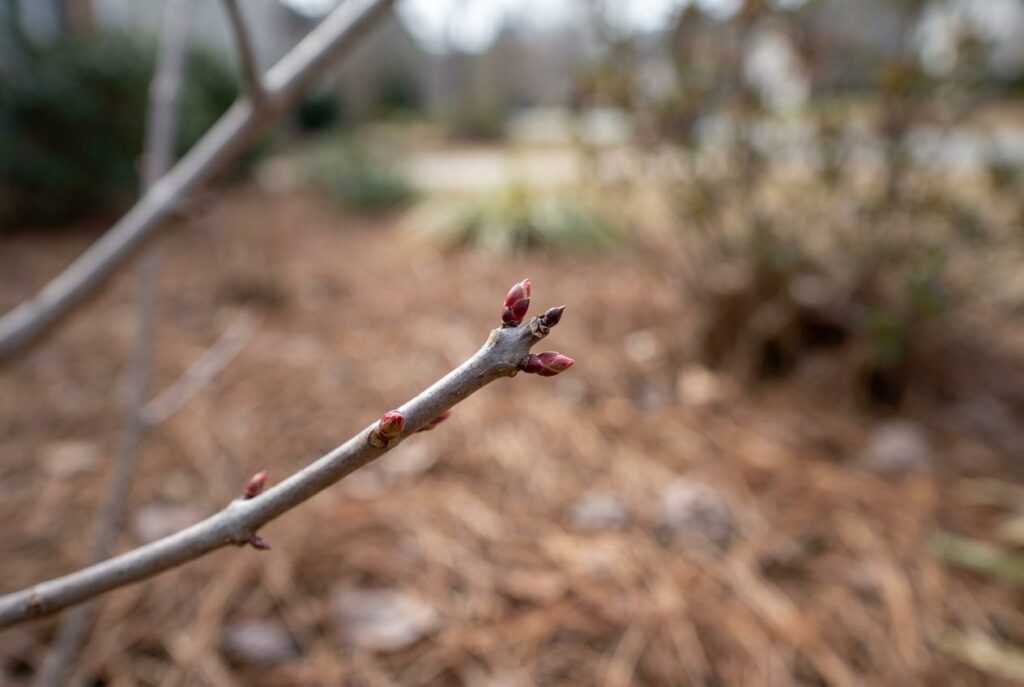
Crepe myrtles flower on new wood, which means this summer’s blooms grow on shoots that have not formed yet in February. Pruning before those shoots appear removes nothing you would have seen in flower. That is why late winter is the safest time, and why pruning crepe myrtles in late spring is one of the most common reasons trees bloom poorly. Once the new growth is out, every cut you make takes flowers with it.
Timing also matters for the health of the tree. Cuts made just before spring growth seal over quickly, because the tree is about to move a large amount of energy into new wood. Cuts made in late summer or fall can push a flush of soft growth that is still tender when the first freeze arrives in Raleigh, and that growth often dies back. Cuts made in the depth of winter simply sit open for longer than they need to.
What Happens If You Prune Crepe Myrtles at the Wrong Time
- Late spring: fewer flowers, because you remove the new shoots that carry blooms
- Summer: heavy cuts stress the tree in Raleigh heat and drought
- Late summer and fall: tender new growth that can be killed by the first freeze
- Early winter: open wounds sitting through the coldest weeks of the year
- Any time, if cut too hard: weak shoots, knuckles and a shorter bloom season
None of these mistakes will kill a healthy crepe myrtle on its own, but they add up over the years. A tree that is pruned at the right time and in the right way needs less work each season, not more. If you have missed the late-winter window, it is usually better to wait until the following February than to make heavy cuts in summer.
What Is Crape Murder and Why It Hurts Crepe Myrtles
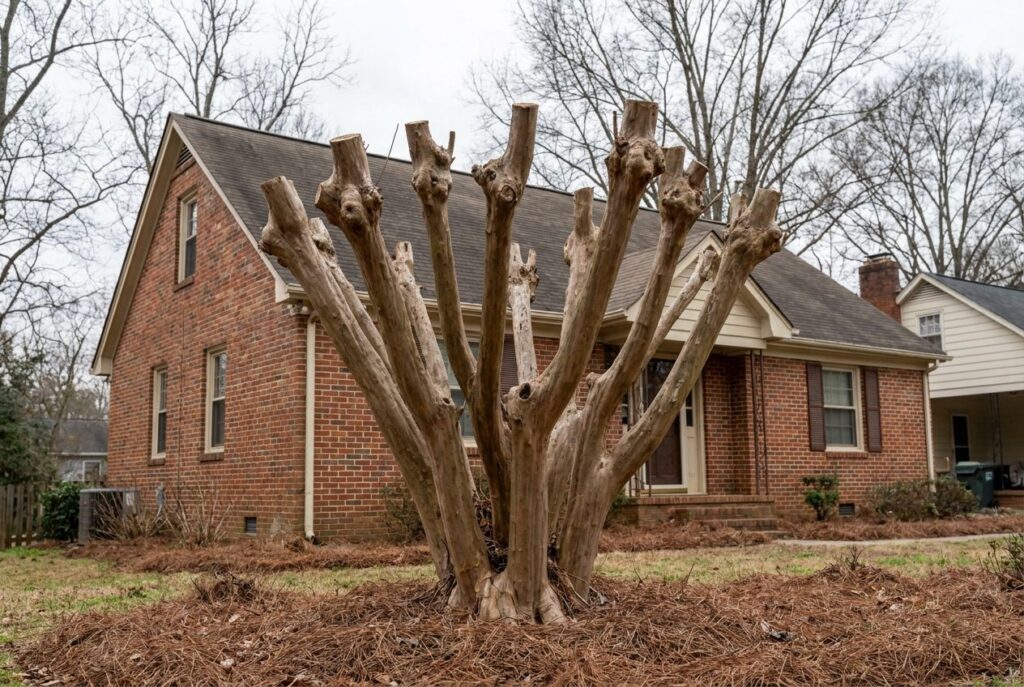
Crape murder is the nickname for topping crepe myrtles, which means cutting every trunk and branch back to the same height every winter. It has become so common in the South that many people assume it is the correct way to prune them. NC State Extension warns that severe pruning like this leads to a shorter bloom time, delayed flowering, weaker branching and more insect and disease problems (NC State Extension). The tree survives, but it never looks or performs the way it should.
When a crepe myrtle is topped, it responds by pushing out a cluster of thin, fast shoots from just under each cut. Those shoots are weakly attached to the trunk, and they bend and sag under the weight of their flowers, then snap in summer storms or ice. Year after year, the repeated cuts in the same spot swell into large, knobby knuckles. The smooth, peeling bark that makes crepe myrtles so attractive in winter is also lost on the heavily cut sections of the tree.
Signs a Crepe Myrtle Has Been Topped
- Thick trunks that end abruptly at the same height
- Swollen knobs or knuckles at the end of each trunk
- Dense clusters of thin, whippy shoots from every cut
- Branches that bend or flop over when the tree is in flower
- Flowers that appear later in summer than on untopped trees
- More bark scale, aphids and sooty mold than on nearby trees
Topping also makes crepe myrtles more attractive to pests. NC State Extension notes that crepe myrtle bark scale is more common on trees stressed by topping (NC State Extension). Our earlier article on tree topping in Raleigh looks at why topping causes so much damage to shade trees as well as crepe myrtles.
How to Prune a Crepe Myrtle Without Topping It
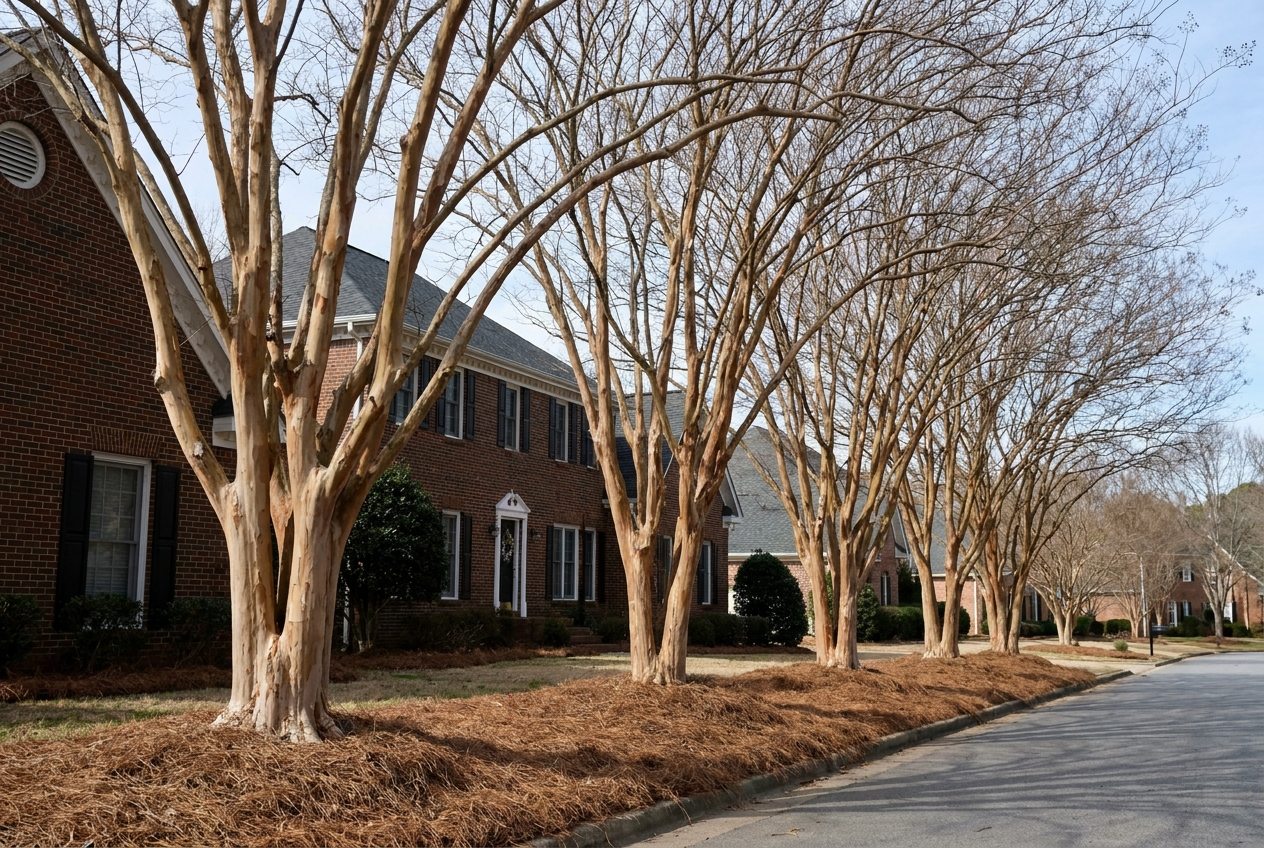
Proper crepe myrtle pruning is about thinning, not shortening. The aim is a tree with three to five well-spaced trunks, an open center and a graceful, vase-shaped crown. Most of the work happens near the base and inside the canopy, and very little of it happens at the top. As a rule of thumb, avoid cutting branches thicker than a pencil at the tips, and never remove more than about a quarter of the living crown in a single dormant season (NC State Extension).
How to Prune a Crepe Myrtle Step by Step
- Step 1: Remove suckers. Cut every sucker growing from the roots or the lower trunk flush with the base, using sharp hand pruners.
- Step 2: Take out dead and damaged wood. Remove any dead, broken or diseased branches back to healthy wood or to the trunk.
- Step 3: Choose the main trunks. On multi-stem trees, keep three to five strong, well-spaced trunks and remove weaker ones at the base.
- Step 4: Clear the lower trunks. Remove small side branches along the lower third to half of each trunk to show off the bark.
- Step 5: Thin the center. Remove crossing, rubbing and inward-growing branches so light and air reach the middle of the tree.
- Step 6: Tidy the tips lightly. Remove old seed heads and twigs no thicker than a pencil, cutting back to a side branch or bud.
Every cut should be made just outside the branch collar, the slightly swollen ring where a branch meets a larger limb or trunk. Leaving a stub invites decay, and cutting flush into the collar makes a larger wound that heals more slowly. For anything above shoulder height, a stable orchard ladder and a sharp pruning saw make the job far safer than standing on a step stool with loppers. Our crape myrtle pruning service handles taller trees with the right ladders and climbing gear.
★★★★★
“The Ashland Tree Service team was great. Came in, worked quickly pruning some large oaks, left the yard clean.”
Dan L. · Verified Google Review
How to Fix a Topped Crepe Myrtle in Raleigh
A crepe myrtle that has been topped for years can almost always be brought back. The process takes patience, usually two or three growing seasons, but the tree has a strong will to grow and responds well to steady, careful pruning. Many of the crepe myrtles we restore in Raleigh neighborhoods look natural again within three summers. Fixing a topped tree costs far less than replacing a mature one.
In the first late winter, we look at each knuckle and choose one or two of the strongest, best-placed shoots growing from it. All of the other shoots on that knuckle are removed, which sends the tree’s energy into the branches that will become its new framework. Over the next two seasons, those chosen shoots thicken and lengthen, and we keep thinning around them so they grow into proper limbs. In some cases, the knuckles themselves can eventually be cut back to a strong new branch.
What to Expect When Restoring a Topped Crepe Myrtle
- Year one: select the strongest shoots on each knuckle and remove the rest
- Year two: thin around the chosen branches and remove new competing shoots
- Year three: the tree has a natural shape and stronger limbs carrying flowers
- Every year: remove suckers and keep the center open
- Never: cut the tree back to the old stubs again
Some badly topped trees are better cut close to the ground and allowed to regrow as a fresh multi-trunk tree. Crepe myrtles sprout vigorously from the base, and a new framework can form in a few years. We only recommend this when the knuckles are severely decayed, and we will walk you through the options before any cuts are made.
Crepe Myrtle Care in Summer: Seed Pods, Suckers and Second Blooms
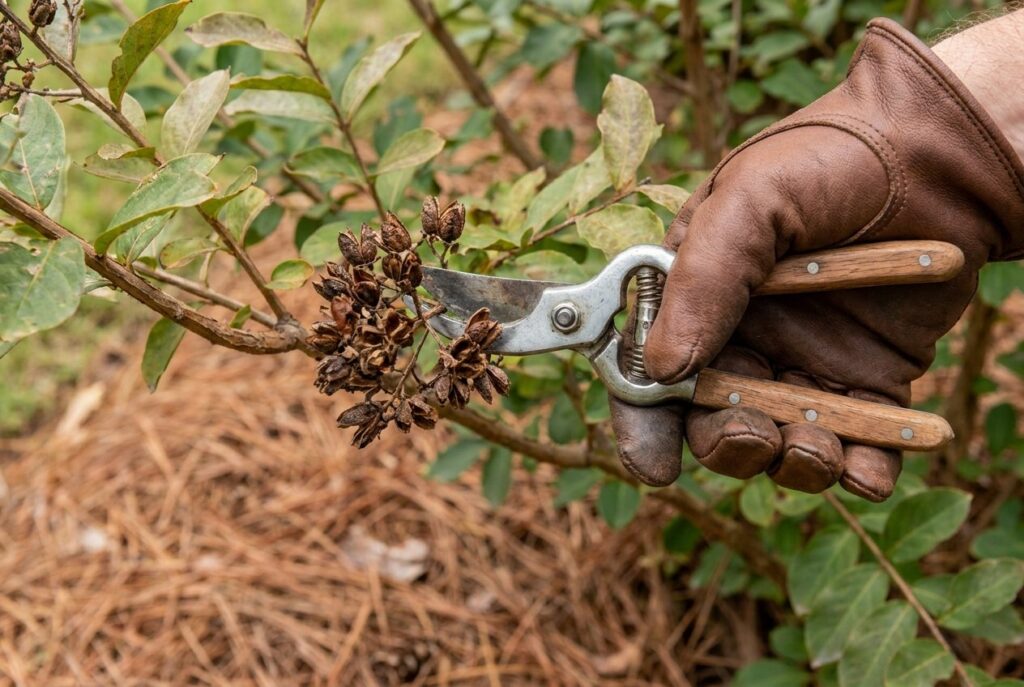
Crepe myrtle care does not stop after the winter pruning. Through spring and summer, suckers keep appearing around the base of the trunks, and they should be cut off whenever you see them. Pulling them tends to tear the bark and encourages more to grow, so a clean cut with sharp hand pruners is the better approach. Keeping the base clear also makes it easier to spot bark scale and other problems early.
Removing crepe myrtle seed pods is optional, but it can be worthwhile. Cutting spent flower clusters back to the first set of leaves early in the summer can encourage a smaller second flush of flowers on many varieties. On taller trees, we only remove seed heads that can be reached safely, because climbing into the canopy to snip twigs causes more harm than good. Old seed heads that remain can be cleared during the late-winter visit.
Summer Crepe Myrtle Care Checklist
- Cut suckers at the base whenever they appear
- Remove spent flower clusters within easy reach in early summer
- Water deeply during long dry spells, especially on young trees
- Keep mulch a few inches away from the trunks
- Check the bark for white, felt-like spots and black sooty mold
- Avoid heavy pruning until the next late-winter window
Watering makes more difference than most people expect. Young crepe myrtles planted in the last two or three years need a deep soak during summer dry spells, while established trees are very drought tolerant. Raleigh’s clay soil holds water well once it is wet, so a slow, deep watering every week or two is better than a light sprinkle every day.
Crepe Myrtle Bark Scale and Other Problems in Wake County
Crepe myrtle bark scale has spread across North Carolina and is now common throughout the Triangle. It shows up as small white or gray felt-like spots on the trunks and branches, often in bark crevices and around old pruning cuts, and the insects inside release a pink fluid when crushed. The scale produces sticky honeydew that grows black sooty mold on the bark and on anything beneath the tree, as described by NC State Extension. Heavy infestations weaken the tree and reduce flowering.
Light infestations can often be cleared by gently scrubbing the trunks with a soft brush and soapy water during winter. Heavier cases may need a soil-applied systemic treatment in early spring, with targeted sprays in late spring and late summer when young scale insects are active. Powdery mildew and aphids are the other common problems on crepe myrtles in Raleigh, and both are worse on crowded trees with poor airflow. Thinning the canopy during the late-winter visit helps with all three.
Crepe Myrtle Too Big for Its Space? Better Options Than Topping
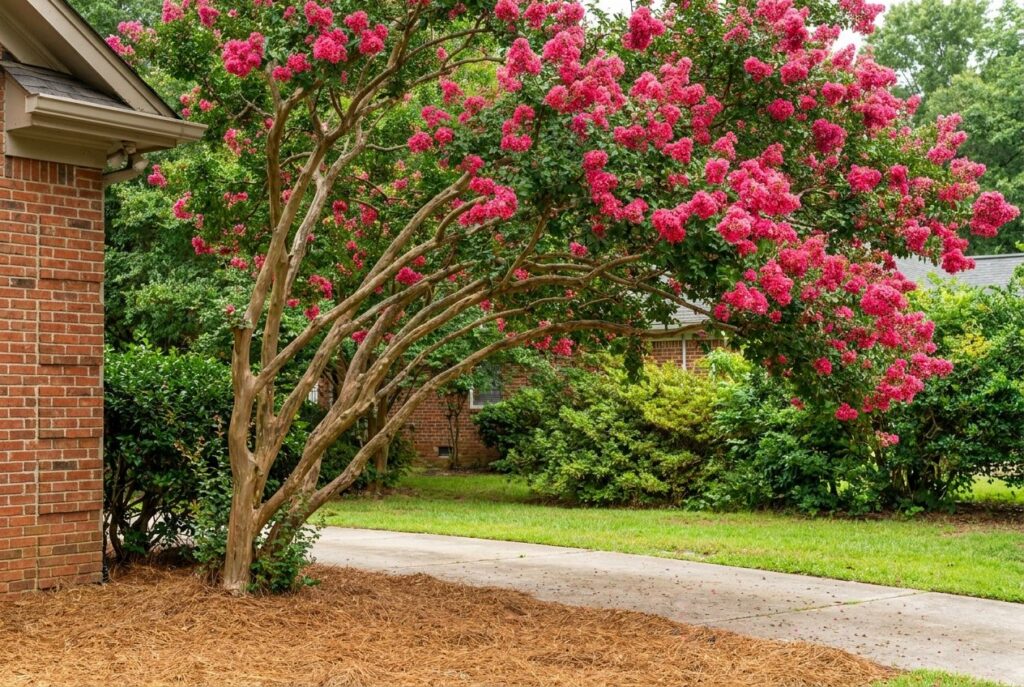
Most topping happens because a crepe myrtle has outgrown its spot next to a house, driveway or power line. Crepe myrtles range from dwarf varieties that stay a few feet tall to tree forms that pass 30 feet (NC State Extension). A large variety planted under a window will try to reach its full size every year, no matter how often it is cut back. Topping it just guarantees a yearly fight with weaker, uglier regrowth.
A crepe myrtle that is only a little too large can be reduced with careful cuts back to side branches, removing whole limbs rather than shortening them all to the same height. If the tree is far too big for its space, replacing it with a smaller variety is often the better long-term answer. Mature crepe myrtles near the house can also be raised and thinned to clear the roof and gutters, which our tree pruning service handles alongside other trees on the property. Smaller flowering plants under the crepe myrtles can be looked after through our shrub and rose bush pruning service on the same visit.
Our Crew at Work Around Raleigh
From crepe myrtles in front yards to large oaks over the roof, our crew handles every pruning job with the same care and cleanup. These are recent jobs from around Raleigh and Wake County.
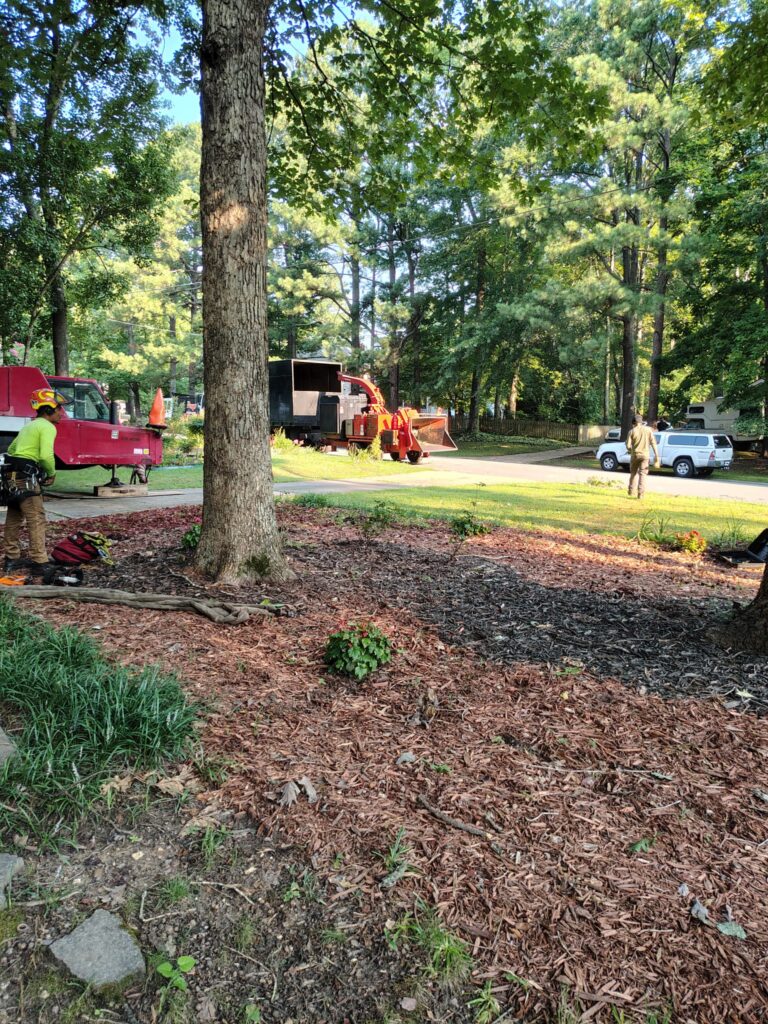
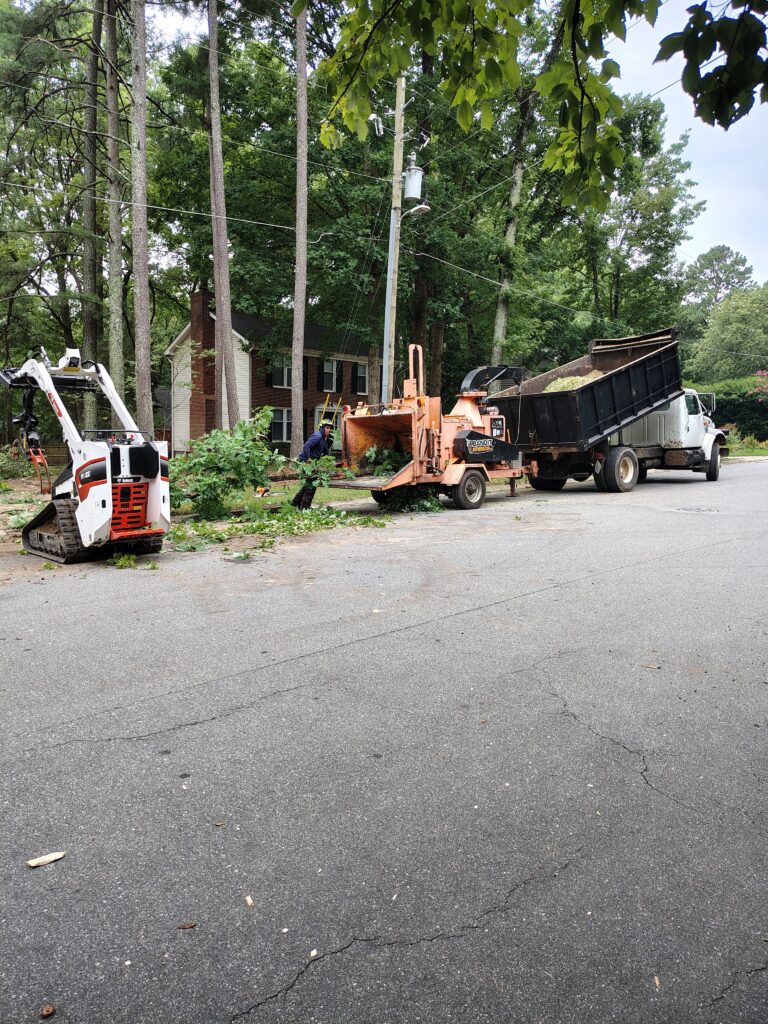
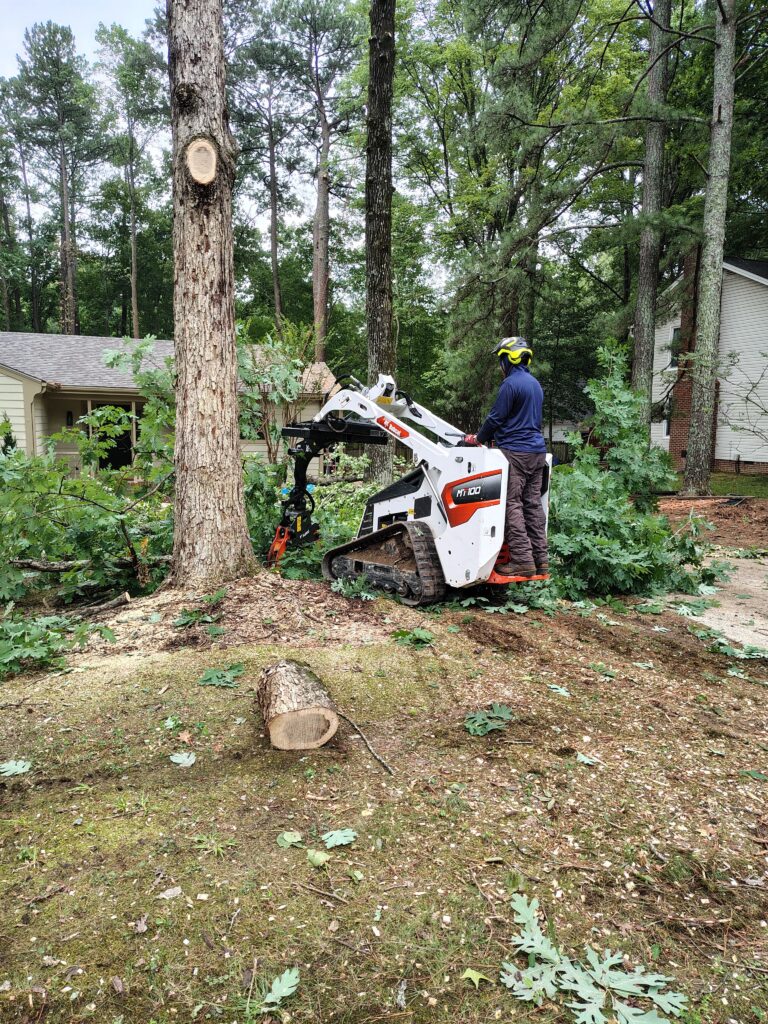
Every job ends with the branches chipped, the beds raked and the driveway blown clean. We leave your property looking better than it was when we arrived.
Crepe Myrtle Pruning FAQs for Raleigh Homeowners
When Is The Best Time To Prune Crepe Myrtles In Raleigh?
Late February to early March is the best time to prune crepe myrtles in Raleigh, while the trees are dormant and just before new growth starts. Crepe myrtles bloom on new wood, so pruning at this time does not reduce summer flowers. Suckers and broken branches can be removed at any time of year.
When Should You Cut Back Crepe Myrtles In North Carolina?
In North Carolina, crepe myrtles should be cut back in late winter, from late February to early March. Cutting back should mean thinning and removing selected branches, not shortening every trunk to the same height. Avoid heavy pruning in late summer, fall and early winter.
How Do You Prune A Crepe Myrtle Without Topping It?
Remove suckers, dead wood and crossing branches first, then keep three to five strong trunks and thin the center so light reaches the inside of the tree. Clear small side branches from the lower trunks and remove only twigs about the thickness of a pencil at the tips. Never cut the main trunks back to stubs.
Should You Prune Crepe Myrtles Every Year?
Crepe myrtles do not need heavy pruning every year. A light visit each late winter to remove suckers, dead wood, crossing branches and old seed heads keeps them healthy and tidy. Young trees benefit from structural pruning in their first few years.
Can A Crepe Myrtle Recover From Crape Murder?
Yes, most topped crepe myrtles recover with careful pruning over two or three years. The strongest one or two shoots on each knuckle are kept and the rest are removed, so the chosen shoots grow into new branches. Badly decayed trees can also be cut near the ground and allowed to regrow.
How Do You Get Rid Of Crepe Myrtle Suckers?
Cut crepe myrtle suckers cleanly at the point where they grow from the root or base of the trunk, using sharp hand pruners. Pulling or mowing them tends to make them grow back thicker. Check the base every few weeks through the growing season.
Is It Too Late To Prune Crepe Myrtles In April?
By April, most crepe myrtles in Raleigh are leafing out, so heavy pruning will remove some of the new wood that carries summer flowers. Light work such as removing suckers, dead wood and crossing branches is still fine. Major structural pruning is best left until the following February.
Will Crepe Myrtles Bloom If They Are Not Pruned?
Yes, crepe myrtles bloom well without pruning, because flowers form on new growth whether or not the tree has been cut. Light pruning can improve flowering on crowded trees by letting more light into the canopy. Topping a crepe myrtle does not increase blooms and often delays them.
I am Steve, and I own Ashland Tree Service. I have spent more than 30 years pruning trees around Raleigh, and crepe myrtles are some of the most rewarding trees to bring back after years of hard cutting. If your crepe myrtles have been topped, have outgrown their space or simply need their late-winter care, call me directly at (984) 328-3971 or book a free estimate. I will walk the trees with you and give you a clear plan and price, and we leave your property looking better than it was when we arrived.