Short version
Tree topping means cutting a tree’s main limbs back to stubs, and it is the single most damaging thing that can be done to a mature tree. It does not make a tree safer. It creates weak, fast-growing regrowth attached to decaying stubs, which is exactly the structure that fails in the next storm. Crape murder is the same mistake applied to crape myrtles every February across Raleigh.
Drive around Wake County in late winter and you will see it everywhere. Oaks and maples cut off flat at twenty feet with nothing left but bare stubs, and crape myrtles reduced to knuckled fists on top of stripped trunks.
Both practices are done with good intentions. Homeowners want a tree made smaller or safer, or they believe crape myrtles need hard cutting to flower. Both beliefs are wrong, and both leave the tree in worse structural condition than before the saw came out. It is the one job our certified arborists in Raleigh routinely turn down, because doing it properly means not doing it at all.
What Is Tree Topping, and Why Is It So Harmful?
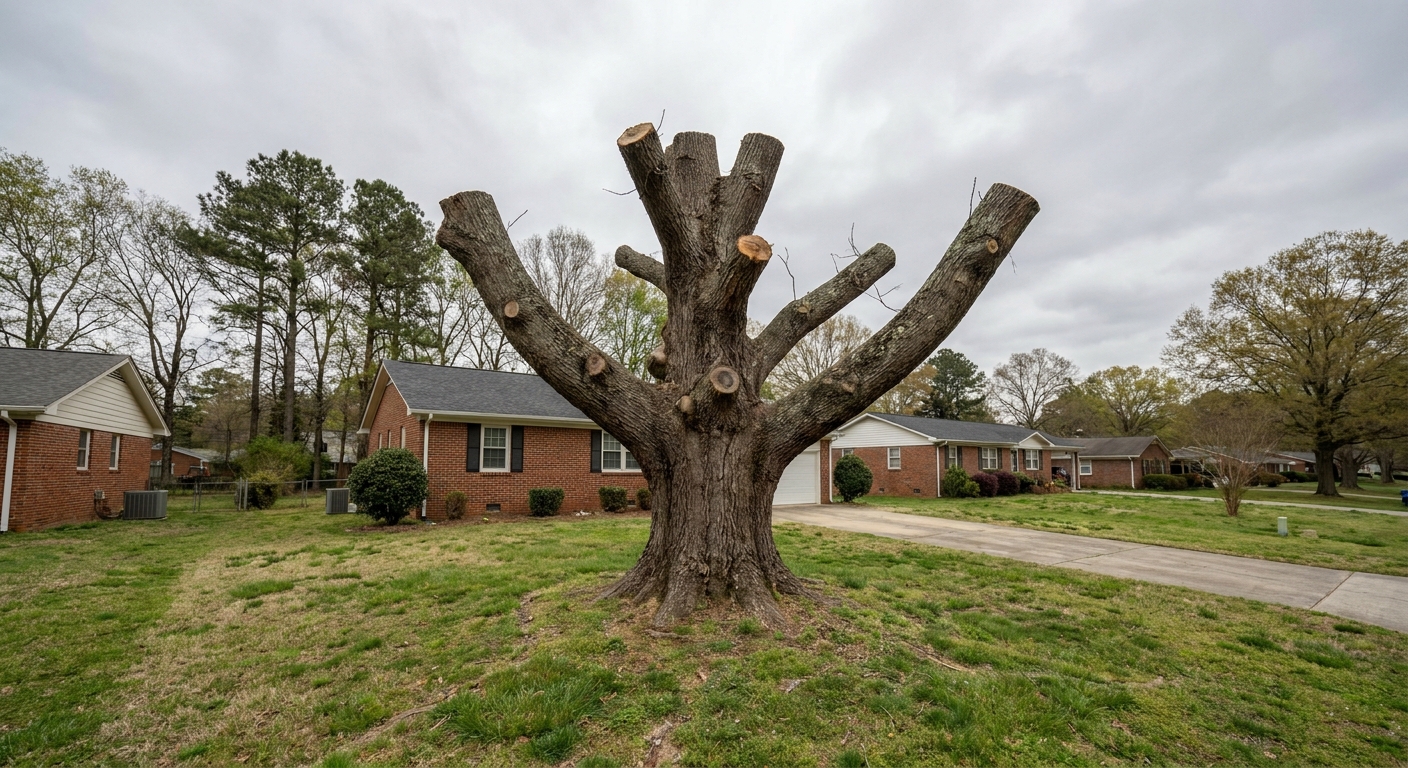
Tree topping is the removal of a tree’s upper branches by cutting through main limbs at an arbitrary point, leaving stubs rather than cutting back to a growth point. It is sometimes sold as hat-racking, rounding over, or simply cutting a tree back, and the name changes far more often than the practice does.
The damage happens on two fronts at once. A tree feeds itself through its leaves, so removing most of the canopy in a single cut starves it, and it responds by dumping stored energy into emergency regrowth. At the same time, every stub is an open wound in the middle of a limb, and a tree cannot seal a cut made there because the natural defence chemistry sits at branch unions, not in the middle of a branch.
What grows back looks reassuring and is not. Those fast vertical shoots, called water sprouts, come from buds just under the bark rather than from the tree’s structural wood, so they are anchored shallowly into a stub that is already beginning to decay.
What topping actually does to a tree:
- Starves it. Removing most of the leaf area at once cuts off the tree’s food supply and drains stored reserves.
- Creates wounds that never close. Cuts in the middle of a limb cannot compartmentalise, so decay moves down into the trunk.
- Produces weaker growth, not less growth. Water sprouts grow faster and taller than the original branches, so the tree is back to its old height within a few years and less safe than before.
- Invites insects and disease. Open stubs and a stressed tree are exactly what borers and decay fungi look for.
- Causes sunscald. Bark that spent decades shaded by canopy is suddenly exposed to full sun, and it splits.
- Destroys the tree’s value. A mature shade tree adds real money to a property. A topped one is a future removal bill.
Penn State Extension put it plainly in their guidance on the practice, and the title says everything a homeowner needs: tree topping costs more than you think. The bill arrives years later, as a removal.
Has Someone Offered to Top Your Tree?
Call us before you agree to it. Our certified arborist will tell you what the tree actually needs, and if the honest answer is nothing, that is what we will say.
Tree Trimming vs Tree Topping: What Is the Difference?

This is the distinction that matters most, and it is not about how much wood comes off. It is about where the cut is made.
Proper pruning removes a branch back to a point the tree can respond to, either at the trunk just outside the branch collar, or back to a lateral branch large enough to take over as the new leader. The tree recognises that boundary and grows callus tissue over it. Topping cuts through the middle of a limb, leaving a stub with no growth point below it, and the tree has no mechanism to close that.
| Factor | Proper pruning | Topping |
|---|---|---|
| Where the cut is made | At the branch collar or back to a suitable lateral | Anywhere along the limb, leaving a stub |
| How much canopy comes off | Usually well under a quarter in one season | Often half or more at once |
| Wound response | Seals over within a season or two | Never seals, decay moves into the trunk |
| Regrowth | Normal, structurally attached branches | Dense weak water sprouts on decaying stubs |
| Effect on storm safety | Improves it by removing deadwood and reducing sail | Makes it worse within three to five years |
| Shape after five years | Natural | Dense broom-like tufts on bare limbs |
If a tree genuinely is too large for its position, the honest options are a proper crown reduction done back to laterals over several seasons, or removal and replanting with a species that suits the space. Topping is not a third option, it is just removal with extra steps and a delay. Our tree pruning service in Raleigh works to those standards, and tree trimming for clearance around roofs and gutters is done the same way.
Crape Murder: Why Raleigh’s Crape Myrtles Get Butchered Every Winter
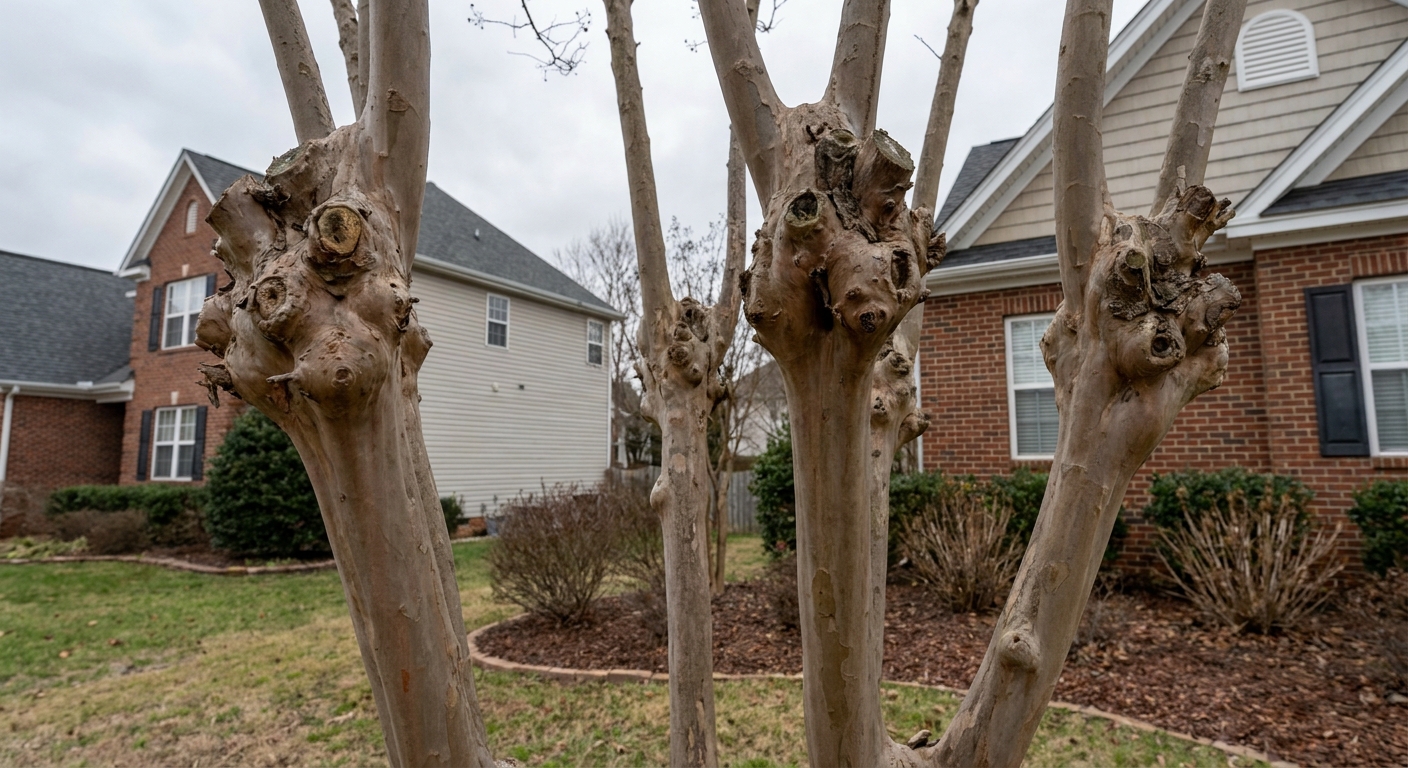
Crape murder is the local nickname for topping a crape myrtle, and it is so common across the South that people assume it is how the tree is supposed to be pruned. It is not, and the crape myrtle is one of the few trees where the damage is visible within a single season.
The belief driving it is that hard cutting produces more flowers. What actually happens is that the tree throws long whippy shoots from the cut knuckles, and those shoots carry blooms that are heavier than the stems can hold. After the first summer rain the whole plant flops outward, which is why so many butchered crape myrtles spend August lying sideways across a driveway.
The knuckles themselves are the lasting problem. Each year’s cut creates a swollen mass of scar tissue, decay works down inside it, and the attachment points get progressively weaker. A crape myrtle topped for a decade has a hollow, knobbled framework holding up growth it was never designed to carry.
Want Your Trees Pruned Properly Instead?
Book a free, no-obligation site visit. We will walk the property, explain what each tree actually needs, and quote only the work that genuinely improves it.
★★★★★
“Ashland Tree Service did a beautiful job of trimming all my trees. The trees looked magnificent once they were trimmed and shaped. A very mature tree in my landscape was severely damaged by a waste management truck. Steven came out to see the tree immediately and took care not to cause any further damage and safely remove the broken half of the tree. I was a happy customer before, now I am a loyal customer.”
Lori P., Raleigh, NC · Verified Google Review
How to Prune a Crape Myrtle Properly in North Carolina
Crape myrtles genuinely do need pruning, just far less of it than they usually get. The goal is to reveal the trunk structure and the beautiful mottled bark, not to reduce the plant’s height.
Timing first. In the Raleigh area, late winter is the window, roughly February into early March, while the plant is still dormant and before new growth begins. Crape myrtles bloom on new wood, so a light dormant prune does not cost you flowers, and pruning too late in spring does.
- Take out the suckers at the base. Anything sprouting from ground level around the trunks, cut it off flush.
- Remove crossing and rubbing branches. Where two limbs are grinding against each other, take the weaker one.
- Clear the interior. Remove twiggy growth inside the canopy so air and light get through.
- Limb up the trunks gradually. Take side branches off the lower trunks over a few seasons to expose the bark, which is the whole point of the plant.
- Cut back to a branch, never to a stub. Every cut should go back to the trunk or to a lateral branch, exactly as with any other tree.
- Leave the top alone. If the tree is genuinely too tall for the spot, it is the wrong cultivar for that spot, and no amount of annual cutting will fix that.
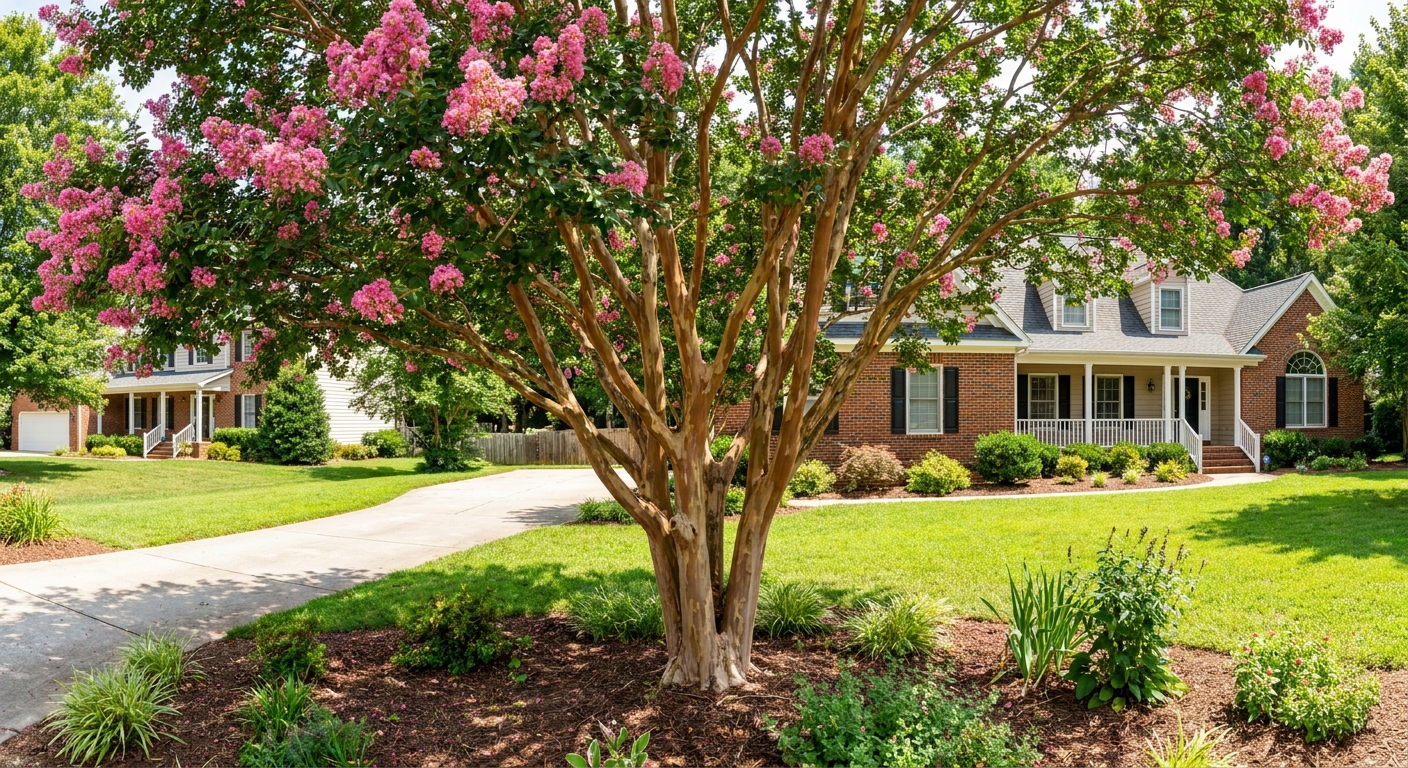
A crape myrtle pruned this way looks like a small multi-trunk tree with clean bark and an open canopy, and it flowers perfectly well. It also stops needing an annual appointment with a chainsaw.
Can a Tree Recover From Topping?

Partly, and it depends heavily on the species, the age of the tree, and how long ago it happened. A young, vigorous tree topped once can often be brought back toward a reasonable structure over several years of careful corrective pruning. A mature oak topped hard usually cannot.
Restoration pruning is the process, and it is slow work. An arborist selects the strongest one or two water sprouts on each stub to become the new leaders, removes the rest, and repeats that over several seasons while the chosen shoots thicken and attach more securely. It never fully undoes the decay already moving inside the stubs, but it can rebuild something closer to a natural shape.
The part homeowners find hardest to hear is that the internal decay continues regardless. A tree topped ten years ago may look green and full today while carrying hollow limb stubs under that growth, and those are the limbs that come down in a summer storm. If that describes a tree near your house, it is worth having assessed rather than assumed to be fine, and if it has already become a hazard our 24/7 emergency tree service in Raleigh deals with the consequences most weeks of storm season.
What Proper Structural Pruning Looks Like Instead
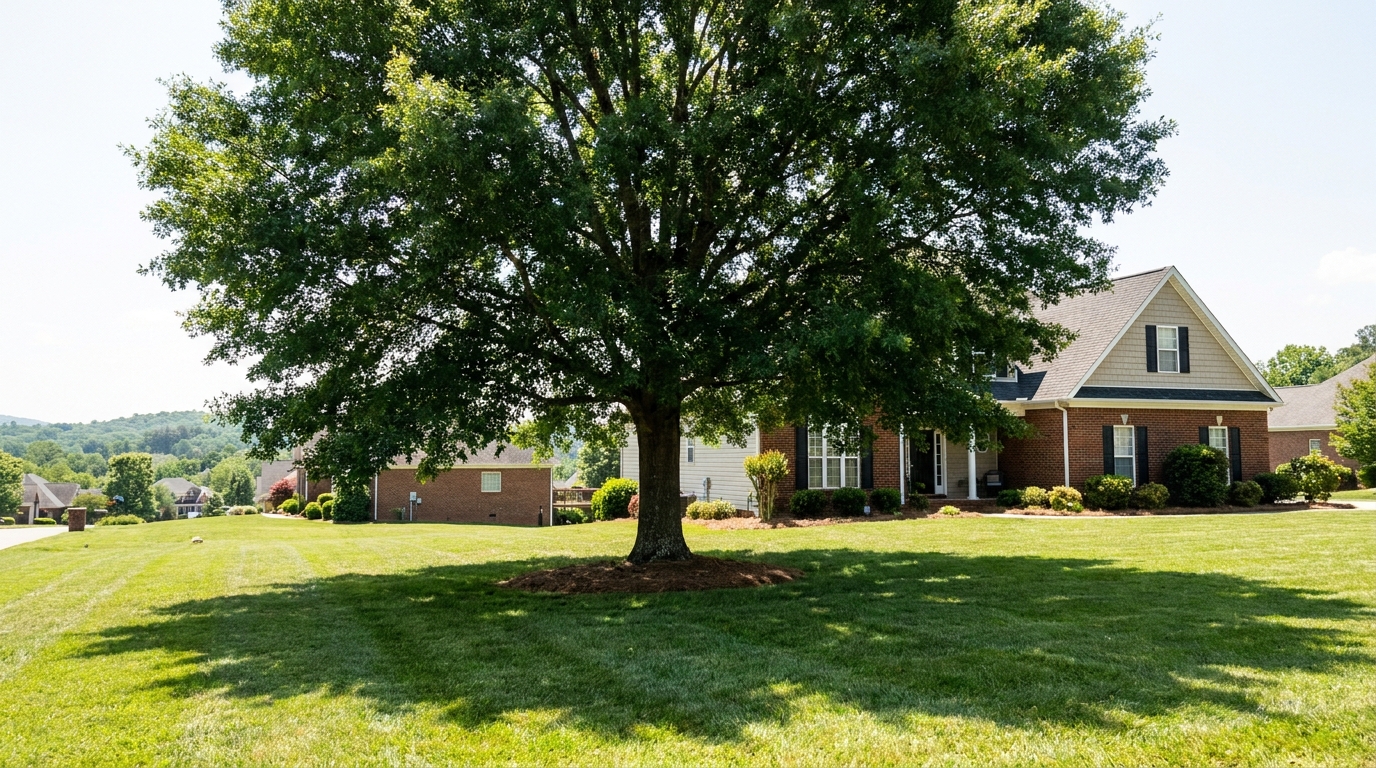
Good pruning is quiet work. When it is finished the tree should look like itself, only tidier, and a stranger walking past should not be able to tell it was done at all.
The techniques that actually achieve what topping is meant to achieve are these. Crown cleaning removes dead, diseased, and broken branches, which is where most genuine storm risk lives. Crown thinning removes selected interior branches so wind passes through instead of pushing against a solid sail. Crown raising lifts the lower canopy for clearance over a roof, a drive, or a footpath. Crown reduction, where a tree really must be made smaller, shortens limbs back to laterals large enough to assume the growth, which keeps the tree’s defence system intact.
All four remove far less wood than topping does, and all four leave the tree stronger rather than weaker. Safety is the point of the exercise, and topping fails at exactly the thing it is sold to deliver. Where a tree genuinely has outgrown its position beyond what pruning can fix, honest tree removal in Raleigh and a better-suited replanting beats pretending a chainsaw can shrink it permanently.
Frequently Asked Questions About Tree Topping and Crape Myrtle Pruning
Is topping a tree ever a good idea?
No, and there is no serious disagreement about that among arborists. Every professional standard and every extension service treats it as damaging, because it starves the tree, creates wounds it cannot seal, and produces weaker regrowth. If a tree is too big for where it stands, the honest choices are a proper crown reduction or removal and replanting.
What is the difference between tree trimming and tree topping?
Where the cut lands. Trimming and pruning remove a branch back to the trunk collar or to a lateral big enough to take over, which the tree can seal. Topping cuts through the middle of a limb and leaves a stub with no growth point below it, which the tree cannot seal. It is not a matter of how much comes off, it is a matter of whether the cut respects the tree’s structure.
Can a tree recover from being topped?
A young vigorous tree topped once can often be brought back toward a reasonable structure through restoration pruning over several years. A mature tree usually cannot. The visible regrowth is not the issue, because that comes back readily. The decay working down inside the stubs continues regardless, and that is what eventually fails.
When should I prune crape myrtles in Raleigh?
Late winter, roughly February into early March here, while the plant is still dormant and before new growth starts. Crape myrtles flower on new wood, so a light dormant prune costs you nothing in blooms. Pruning late into spring is what actually reduces flowering, which is the opposite of what most people assume.
Does cutting a crape myrtle back hard give you more flowers?
No. It gives you fewer, larger flower heads on long whippy shoots that cannot hold the weight, which is why hard-cut crape myrtles flop over after the first summer downpour. A properly pruned crape myrtle produces more blooms spread across a stronger framework, and it holds them upright.
My crape myrtle has already been topped for years. Can it be fixed?
Usually yes, and crape myrtles are far more forgiving than shade trees. The approach is to stop cutting the knuckles, select the strongest shoots from each one to become permanent limbs, remove the rest, and let them thicken over two or three seasons. It looks awkward for a year and then starts to look like a tree again.
Will topping make my tree safer in storms?
It does the opposite, on a delay. For the first year or two the tree is shorter and looks safer, then the water sprouts grow back faster than the original branches and sit on stubs that are now decaying. Three to five years after topping you have tall weak growth on weak attachments, which is a worse storm risk than the tree you started with.
A tree company offered to top my tree. Should I use them?
Treat it as a warning sign about the company rather than an option to weigh up. A firm offering to top a healthy shade tree is either unaware of current practice or willing to damage a tree for the sale. Ask any contractor where they intend to make their cuts, and if the answer is not the branch collar or a suitable lateral, get another quote.
How much of a tree can safely be pruned at once?
Well under a quarter of the living canopy in a single season for a mature tree, and less than that for one already stressed. Topping frequently removes half or more in one visit, which is the root of the problem. If a tree needs a large reduction, it should be staged across several years rather than done in one afternoon.
Is a topped tree worth keeping or should it come out?
It depends on what it is threatening. A topped tree in an open corner of the garden can be left to do its thing and managed with restoration pruning. A topped tree standing over a roof, a driveway, or a play area is a different calculation, because the failure point is inside the stubs where you cannot see it. That is the situation worth having looked at properly.
I am Steve, and I own Ashland Tree Service. In 30+ years I have never topped a healthy tree for a customer, and I have turned down the work plenty of times, because the job that looks cheap in February becomes a removal bill five years later. Call me directly at (984) 328-3971 or book a free estimate, and I will walk the property with you and tell you what each tree genuinely needs, even when that answer is nothing at all. And we leave your property looking better than it was when we arrived.