Raleigh Willow Oaks at a Glance
Willow oaks are native to North Carolina, fast growing and long lived, and they shade many of Raleigh’s older streets and yards. Many of the biggest ones are now old, and years of drought, root damage from construction, and compacted soil leave them open to decay, hypoxylon canker, root rot, and ambrosia beetles. A willow oak with a thinning crown, dead limbs, bark falling away, or mushrooms at the base needs an arborist’s eyes. Removal makes sense only when decay or dieback means the tree can no longer stand safely over your home, and a healthy oak is always worth keeping.
Raleigh is known as the City of Oaks, and the willow oak is one of the trees that keeps the name honest. Those tall, fine-leaved canopies over older streets and back yards are a big part of why so many families love living here. They are also some of the largest and heaviest trees standing next to houses anywhere in Wake County. When one of them starts to decline, the risk to your home grows with every season it is left alone.
Oak removal is the job our customers mention most, and very few of those trees came down on a whim. Most had been dropping limbs, thinning out, or showing decay at the base for years before anyone called us. Our crews would always rather help you keep a healthy oak than take one down. When a willow oak has reached the point where it is no longer safe, though, we remove it carefully, and we leave your property looking better than it was when we arrived.
Willow Oak Trees in Raleigh: Why the City of Oaks Is Losing Its Giants
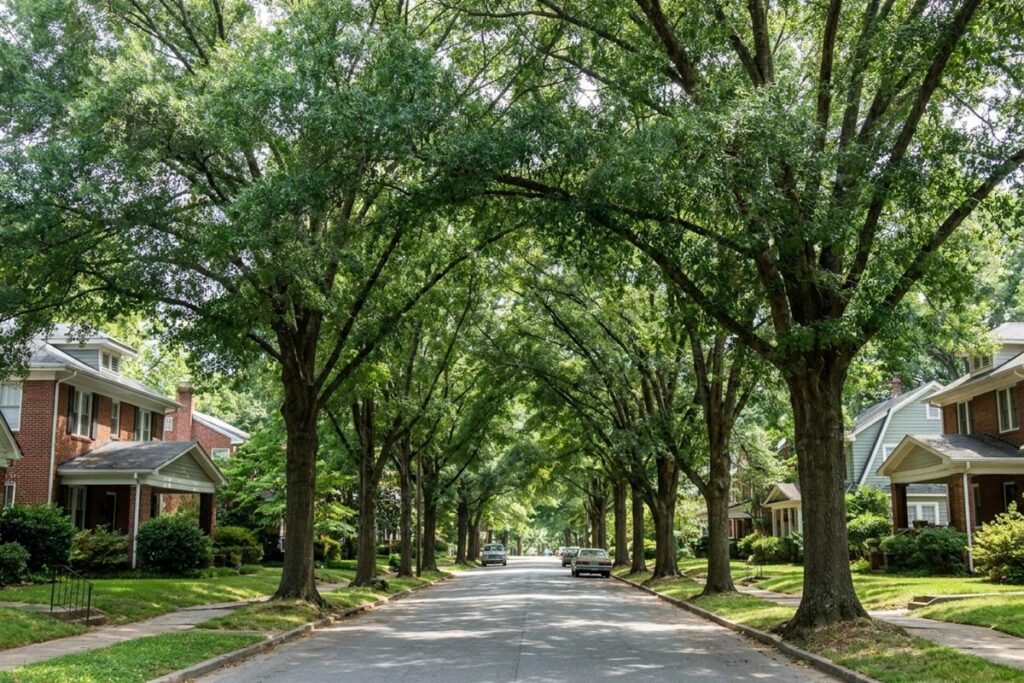
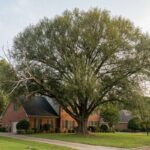
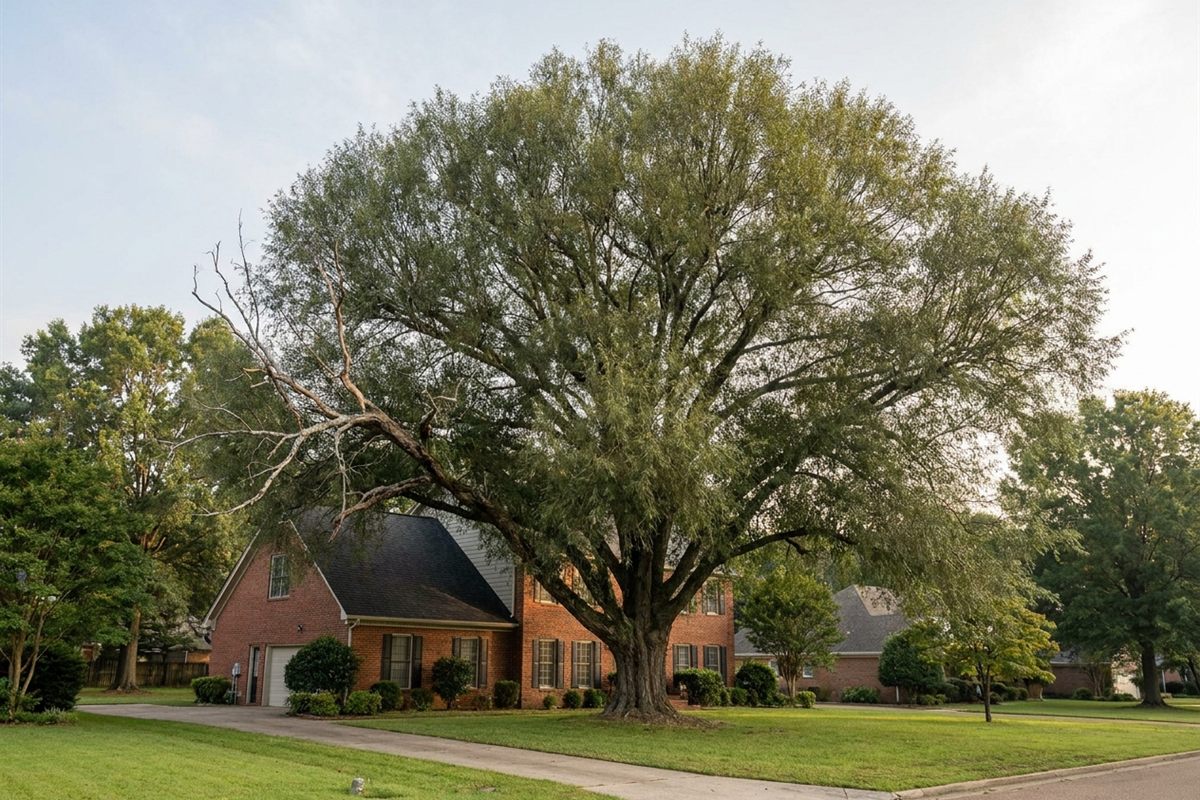
The willow oak (Quercus phellos) is a native North Carolina oak, and it looks nothing like the broad-leaved oaks most people picture. Its leaves are narrow and smooth-edged, roughly four to five inches long and about an inch wide, which is where the willow comparison comes from. It grows fast, typically reaching 40 to 75 feet tall and 25 to 50 feet wide, and big specimens can top 100 feet. Because it handles clay soil and city conditions well, it has been planted as a street tree and shade tree across Raleigh and the Triangle for generations.
The Willow Oak Tree at a Glance:
- Leaves. Narrow, smooth-edged willow oak leaves about 4 to 5 inches long and 1 inch wide.
- Size. 40 to 75 feet tall and 25 to 50 feet wide at maturity, and sometimes over 100 feet.
- Growth. Fast growing, which puts a lot of weight over a roof in a relatively short time.
- Roots. A fibrous root system that suffers when soil is dug, trenched, graded, or compacted nearby.
- Oak group. A member of the red oak group, which matters for several common oak diseases.
- Weak point. Susceptible to wind damage, and far more so once decay has set in.
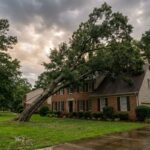
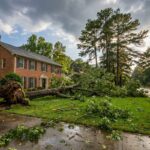
Willow oaks are long lived, and they hold up to insects and disease better than many other oaks. They are also susceptible to wind damage, and that is the part Raleigh homeowners feel after a summer thunderstorm or the tail end of a tropical storm. A mature tree carries tons of wood over roofs, driveways, cars, and power lines. When the wood inside is sound, that weight is not a problem. When it is not, a big limb or the whole tree can fail with very little warning.
Age is the biggest reason so many old willow oaks are struggling now. Downtown, the City of Raleigh has had to take down willow oaks in Nash Square and Moore Square after testing found internal decay, and the Moore Square tree was judged to be around 200 years old. Arborists who reviewed those trees concluded that pruning or reducing the crowns would not have removed the risk of failure. The same story plays out on a smaller scale in back yards all over the city, where oaks that shaded a house for decades are now carrying hollow sections, dead limbs, and weakened roots.
Old age rarely acts alone. Decades of paving, driveway widening, new foundations, utility trenching, and heavy equipment parked over the roots all take a toll, because a tree loses about as much canopy as it loses roots. Summer droughts pile more stress on top of that, and a stressed oak is exactly what decay fungi and boring insects are drawn to. Safety is the reason to pay attention early, since the tree often looks fine from the street long after the damage has started.
Worried About an Old Oak Over Your House?
Our certified arborist will walk the tree with you, check the crown, trunk, and root flare, and give you a straight answer on whether it can safely stay. Every estimate is free and comes with no obligation.
Dying Oak Tree Symptoms Raleigh Homeowners Should Never Ignore
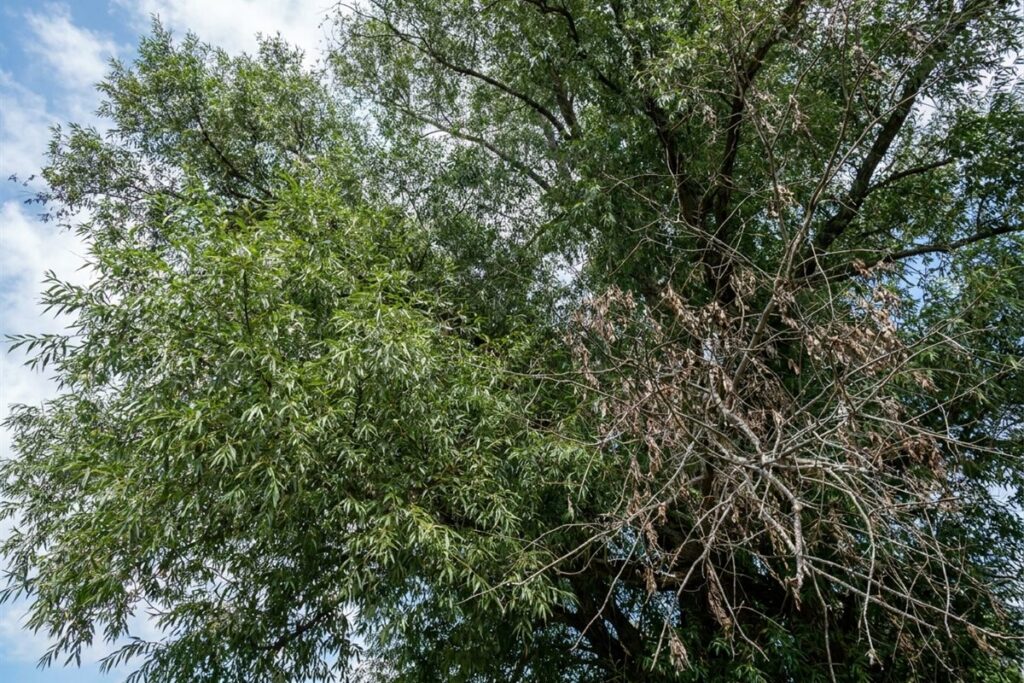
A dying oak tree rarely goes all at once. Most willow oaks decline over several seasons, and the early symptoms are easy to put down to a dry summer. The trouble is that by the time a whole side of the crown is bare, the problem underneath is usually well advanced. Knowing the warning signs lets you act while there are still choices, whether that means care, pruning, or a planned removal on your schedule.
Signs an Oak Tree Is Dying:
- Thinning crown. More sky showing through the canopy each year, or leaves that come out smaller than normal.
- Dieback at the tips and top. Bare grey twigs and branch ends that no longer leaf out in spring.
- Dead limbs. Large branches with no leaves, loose bark, or cracks where they join the trunk.
- Early leaf browning. Leaves scorched along the edges or turning brown in mid to late summer.
- Bark falling away. Patches of bark sloughing off the trunk or big limbs, sometimes revealing crusty tan, brown, or black fungal mats.
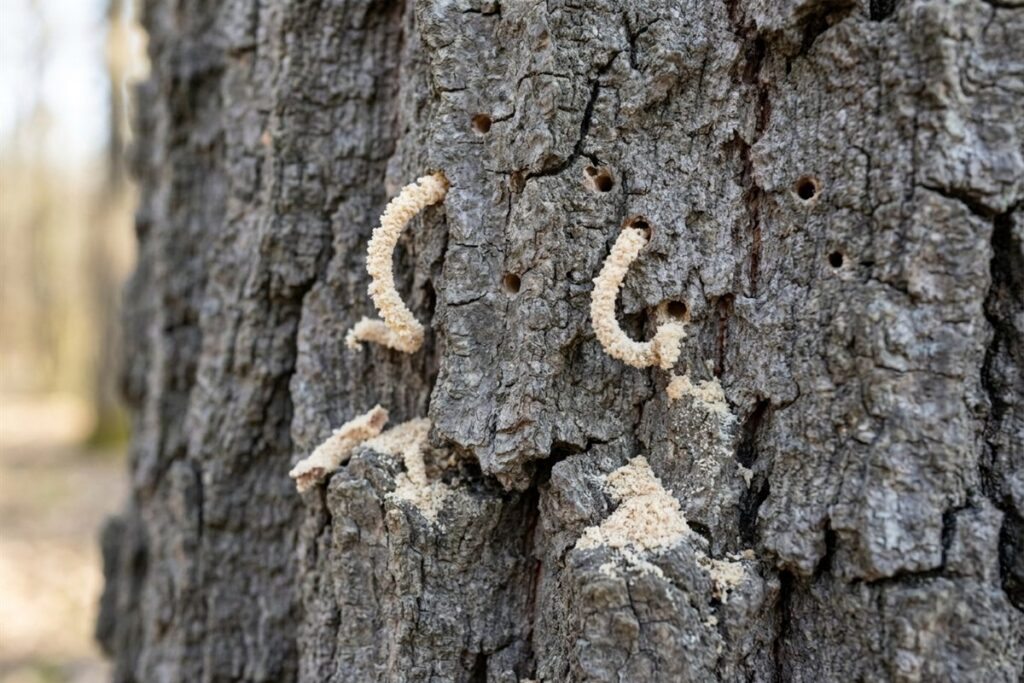
- Sawdust strands. Thin, toothpick-like strands of boring dust sticking out of tiny holes in the bark.
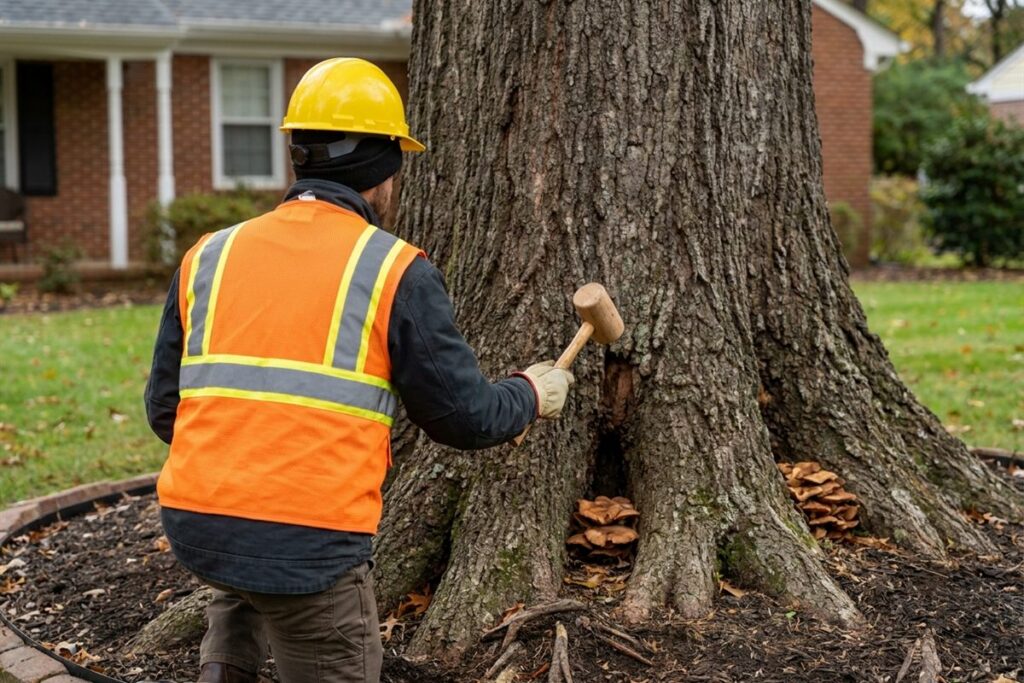
- Trouble at the base. Clusters of mushrooms, spongy or wet bark, or open cavities at the root flare.
- New lean or heaving soil. A tree that has started to lean, or cracked and raised soil on one side of the trunk.
One of these signs on its own does not always mean the tree is dying. A few dead branches in a big old oak are normal, and a dry August can brown the leaves on a perfectly healthy tree. Two or three signs together, especially dieback in the crown plus trouble on the trunk or at the base, is a very different story. For a quick first look before we visit, our tree risk checker walks you through the same questions we ask on site.
Some trees are already past saving by the time anyone notices. A willow oak that did not leaf out at all in spring, or one with bark peeling away from much of its trunk, may already be a dead oak tree standing, and dead oak wood becomes brittle surprisingly quickly. A dead or badly decayed oak is also far more dangerous to climb and cut, which changes how our crew has to take it down. Until the tree has been looked at, keep children, pets, and parked cars out from under any oak that is dropping limbs.
★★★★★
“Steven and his crew did a great job removing a very large dead oak and trimming up three other trees around my home today. The crew went about their duties efficiently and with precision.”
Tony S. · Verified Google Review
Ambrosia Beetles, Hypoxylon Canker and Decay in Wake County Willow Oaks
Most of the willow oaks we see failing around Raleigh are not killed by a single pest. They are weakened first by age, root damage, or drought, and then secondary insects and fungi move in and finish the job. That is why treating the one insect you can see rarely saves the tree. Each of the oak tree disease and pest problems in the table has its own look, and each tells you something different about how safe the tree is to keep.
| Willow oak problem | Signs you can see | What it means | What to do |
|---|---|---|---|
| Ambrosia beetles | Tiny pinholes with toothpick-like strands of boring dust, wilting leaves | The tree was already stressed enough to attract them, and beetles inside the wood cannot be sprayed | Have the whole tree inspected; heavily attacked, declining oaks are usually a removal |
| Hypoxylon canker | Bark sloughing off, tan or reddish-brown fungal mats turning black then grey, thin crown | A fungus has taken over stressed sapwood, and there is no chemical cure | Hazard assessment; widespread canker on a large oak near the house usually means removal |
| Armillaria root rot | Mushroom clusters at the base, spongy or wet bark, white fans under the bark, black string-like strands | Roots and the lower trunk are decaying, weakening the tree’s anchor in the ground | Treat it as a safety issue and get the root flare checked promptly |
| Internal decay | Hollow sound when tapped, open cavities, seams, old wounds that never closed | A shell of sound wood may be hiding a hollow trunk or limb | Decay check by an arborist; remove if too little sound wood is left |
| Construction root damage | Dieback that began a few years after digging, grading, a new driveway, or fill soil near the trunk | The tree lost roots and is shedding canopy to match | Water in dry spells, mulch, protect the roots, and monitor; remove if the decline keeps going |
| Bacterial leaf scorch | Leaf edges browning in mid to late summer, with a yellow band between brown and green tissue | A bacterial disease spread by leafhoppers that comes back each summer and can weaken oaks over several years | Keep the tree watered and watched; plan ahead if dieback builds |
| Oak wilt | Fast wilting and leaf loss across the crown | Found in several western North Carolina counties and most damaging to the red oak group | Get a proper diagnosis rather than assuming, since drought, canker, and root damage cause wilting too |
Ambrosia Beetle Damage on Stressed Oaks
Ambrosia beetles are tiny, and the granulate ambrosia beetle measures only about an eighth of an inch long. They bore into the wood and grow a fungus inside their tunnels, pushing out fine strands of boring dust that can stick out of the bark as much as an inch and a half before wind and rain knock them off. They attack a wide range of trees in North Carolina, oaks included, and they are drawn to trees that are already under stress. Activity peaks in March and early April, but the beetles stay active at lower levels right through summer and into fall.
Once the beetles are inside a tree, insecticides cannot reach them, so ambrosia beetle treatment really comes down to prevention and tree health. On a young or newly planted tree, keeping stress low through watering and avoiding injury is the best protection. On a big old willow oak, beetle strands on the trunk tell us the tree is already in serious trouble. We take that as a signal to look hard at the rest of the tree, because the beetles are rarely the only problem it has.
Hypoxylon Canker on Oak Trees
Hypoxylon canker, now also called Biscogniauxia canker, is a fungus that lives quietly inside many hardwoods and only turns destructive when a tree is stressed by drought, injury, compacted soil, or root damage. Red oaks are more susceptible than white oaks, and willow oaks belong to the red oak group. The giveaway is bark dropping off the trunk or big limbs to reveal fungal mats that start tan or reddish-brown and harden to black and then grey. There is no chemical cure, and the wood underneath dies and weakens, so an oak with widespread canker is a tree we examine closely for safety before anyone works near it.
Root Rot, Hidden Decay and Construction Damage
The problems you cannot see are often the most dangerous. Armillaria root rot, also known as shoestring root rot, decays the roots and base of the tree and shows itself with clusters of mushrooms, spongy bark, and white fungal fans under the bark. Internal decay can hollow out a trunk or a main limb while the crown above still looks green and full. Construction damage works more slowly, because roots cut or crushed by digging, grading, or fill soil often show up as canopy dieback several years later, long after the builders have gone and the tree seemed to have survived.
Not Sure What Is Wrong With Your Oak?
We will come out, look at the crown, trunk, and base, and tell you honestly whether the tree can be saved or needs to come down. No pressure, and no guesswork.
Can a Dying Oak Tree Be Saved? Willow Oak Care in Raleigh
Sometimes, yes. An oak that is stressed but still structurally sound can often recover, or at least stay safe for many more years, with the right care. What nobody can do is reverse advanced decay, kill beetles that are already inside the wood, or cure hypoxylon canker once it has spread through the trunk. The honest answer depends on how much sound wood is left, where the tree stands, and what it would land on if it failed.
What Helps a Stressed Willow Oak:
- Water during dry spells. A slow, deep soak across the root zone during summer droughts, not a quick sprinkle at the trunk.
- Mulch the root zone. A wide ring of mulch, pulled back from the trunk, holds moisture and keeps mowers and foot traffic off the roots.
- Protect the roots. Keep vehicles, trenching, and new fill soil out of the area within about 30 feet of a mature trunk.
- Remove dead wood. Taking out dead and hazardous limbs cuts the risk of branches falling on people, cars, and roofs.
- Never top the tree. Cutting the top out of an oak weakens it and invites decay rather than saving it.
- Check it every year. Look at the crown in early summer and the trunk and base each season, and call us if anything changes.
Proper pruning is often the best thing you can do for an old oak that still has good bones. Our tree pruning service focuses on removing dead, dying, and crossing limbs and reducing weight over the house without stripping the tree, working from a bucket truck or by climbing depending on access. Heavy cuts do more harm than good on a stressed willow oak, because every large wound is a new way in for decay. Our certified arborists plan each cut with the tree’s long-term health and your family’s safety in mind.
Care only makes sense when the tree is safe to keep. If we find extensive decay, a hollow trunk, a cracked union, or root rot at the base of a large willow oak next to a house, we will tell you plainly that it needs to come down. We never recommend removing a healthy oak just to fill a work order. Whether the answer is pruning, monitoring, or removal, our job is to give you the facts and keep your family and your home safe.
★★★★★
“Ashland tree service provided a fair estimate to remove three oaks in our property in Raleigh NC. They were on time and professional. We are more than satisfied.”
Michael H., Raleigh, NC · Verified Google Review
When to Remove a Willow Oak in Raleigh: Safe Oak Tree Removal Near Your Home
Removal is the right call when a willow oak can no longer stand safely where it is. We weigh the condition of the tree against what sits underneath it, because a declining oak at the back of a wooded lot is a very different risk from the same tree leaning over a bedroom. If the tree stands in the street right of way, it may be a city tree, and the City of Raleigh’s urban forestry team manages those. On your own property, the decision and the responsibility are yours, and we are glad to help you make it with the full picture.
Signs a Willow Oak Needs to Come Down:
- Large dead sections. Big parts of the crown are dead or failed to leaf out this spring.
- Canker on the trunk. Bark is sloughing away with hypoxylon canker mats on the trunk or main limbs.
- Decay at the base. Mushrooms, soft wood, or cavities at the root flare point to rot in the tree’s anchor.
- Hollow or cracked trunk. The trunk sounds hollow when tapped, or has open cracks and seams.
- Beetles on a declining tree. Ambrosia beetle strands appear on an oak that was already thinning.
- A new lean. The tree has started leaning, or the soil is heaving and cracking on one side.
- A target underneath. The tree is dropping large limbs over the house, driveway, play area, or power lines.
How We Remove a Large Oak Near a House
Taking down a mature willow oak beside a home is technical work, and safety drives every decision our crew makes. Decayed wood does not behave like sound wood when it is cut, so we plan for that from the very start. Every property is different, but a typical oak tree removal near a house in Raleigh follows the same sequence. It is the same careful process whether the tree is 40 feet tall or well over 80.
Step 1: Assess the Tree and Plan the Job. Our certified arborist inspects the trunk, crown, and root flare, notes any decay or dead wood, and maps the house, fences, power lines, and landscaping around the tree. We choose the method and equipment based on what we find, and we walk you through the plan before any work starts. If decay means nobody should climb the tree, we plan the job around a bucket truck or crane instead.
Step 2: Set Up the Site Safely. We position the equipment, lay protection over lawns and driveways where heavy machinery will travel, and mark off a drop zone that keeps people and pets well clear. Every crew member wears proper safety gear, and we agree on signals and who calls each cut before the first saw starts. Cars, outdoor furniture, and anything else that can be moved gets moved out of the way.
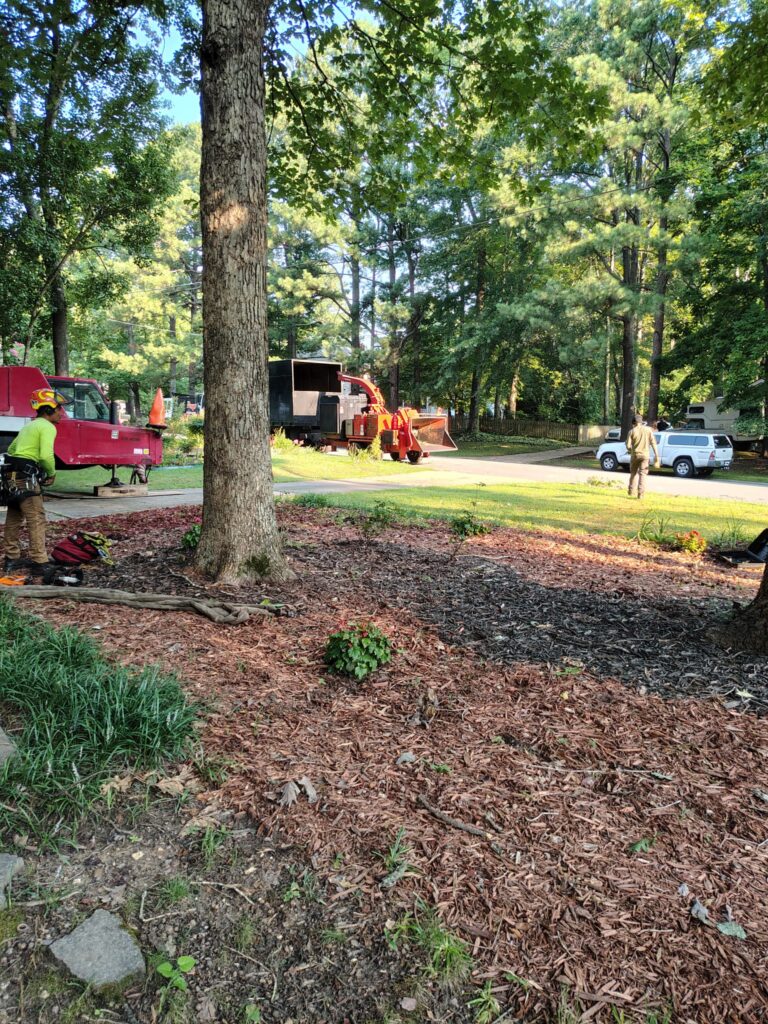
Step 3: Take Down the Canopy in Controlled Sections. Limbs come off one at a time, working from a bucket truck, by climbing, or with a crane. Over a roof or fence, we use rigging to lower each piece on ropes instead of letting it fall. On the biggest oaks, crane-assisted tree removal lets us lift whole sections clear of the house without putting any weight on the structure.
Step 4: Bring Down the Trunk. With the crown gone, we take the trunk down in manageable pieces, lowering them with rigging, lifting them with the crane, or handling them with a grapple saw that cuts and holds each section in one motion. Hollow or decayed trunks get extra care, since they can split or shift in ways sound wood does not. The wood is cut to size and either chipped on site or hauled away.
Step 5: Grind the Stump and Clean Up. Our stump grinder takes the stump down under the soil line so the area can be levelled, reseeded, or replanted. We rake up the chips, blow off driveways and walkways, and haul the debris away. We leave your property looking better than it was when we arrived.
Most of the oaks we take down come through our tree removal service in Raleigh, from a single dead oak in a back yard to several declining trees around one home. Whether the tree is easy to reach or wedged between the house and a neighbor’s garage, we bring the right equipment for that job and do it safely. From the first cut to the last rake of the lawn, the owner’s standards apply on every job. Emergencies are different, and if an oak has already split or come down on your house, call us right away at (984) 328-3971.
Oak Tree Removal Cost in Raleigh
The cost of removing an oak depends mostly on its height, its condition, and what it stands over. Our published ranges are $250 to $500 for trees under 30 feet, $500 to $1,200 for trees 30 to 60 feet, and $1,200 to $1,900 for trees 60 to 80 feet. Oaks over 80 feet, or jobs that need a crane, typically run $1,900 to $4,000 or more. Working over a house, fence, or other structure, or lowering pieces by hand, usually adds $200 to $600 or more, and stump grinding runs $100 to $200 per stump, or $3 to $5 per inch of diameter, with a $100 to $125 minimum.
Many of Raleigh’s mature willow oaks fall into the larger size ranges, so it helps to get a feel for the numbers before we visit. Our tree removal cost calculator gives you a price range in a couple of minutes, and our free on-site estimate turns that into an exact figure for your tree. Planning the removal of a declining oak on your own schedule also spares you the stress and danger of an emergency call after a storm has already brought it down. Either way, you will know the price before any work begins.
Willow Oak and Oak Tree Removal FAQs for Raleigh Homeowners
How Long Do Willow Oaks Live In Raleigh?
Willow oaks are long-lived trees, and in good conditions they can stand for well over a century. The City of Raleigh judged one downtown willow oak in Moore Square to be around 200 years old before decay led to its removal. Yard and street trees usually have harder lives, and compacted soil, root damage, and drought shorten how long they stay healthy.
How Can You Tell If An Oak Tree Is Dying?
Look for a thinning crown, dead branch tips that do not leaf out, large dead limbs, and leaves that brown early in summer. On the trunk, watch for bark falling away, fungal mats, tiny holes with sawdust strands, and mushrooms or soft wood at the base. Two or more of these together is a good reason to have an arborist inspect the tree.
Why Is My Oak Tree Dying?
Most declining oaks around Raleigh are dealing with several stresses at once rather than one disease. Age, drought, root damage from construction or grading, and compacted soil weaken the tree, and then problems like hypoxylon canker, root rot, and ambrosia beetles take advantage. Finding the underlying cause is what tells you whether the tree can recover.
How Do You Save A Dying Oak Tree?
A stressed oak that is still structurally sound can often be kept going with deep watering in dry spells, mulch over the root zone, protection from root damage, and careful pruning of dead wood. An oak with advanced decay, widespread hypoxylon canker, or root rot at the base cannot be brought back. In that case the safest choice is a planned removal before it fails.
What Does Ambrosia Beetle Damage Look Like?
The clearest sign is thin, toothpick-like strands of compressed sawdust sticking out of tiny holes in the bark, which can reach about an inch and a half long. Leaves on the affected tree or branch may also wilt. On a big oak, the beetles usually signal that the tree was already under serious stress.
Is There A Treatment For Ambrosia Beetles?
Not once they are inside the tree, because insecticides cannot reach beetles in their tunnels. Prevention comes down to keeping trees healthy and free of stress from drought and injury. On a large declining oak, we focus on how safe the tree is rather than chasing the beetles.
Do Oak Trees In North Carolina Get Oak Wilt?
Oak wilt has been found in several counties in western North Carolina, and it is most damaging to the red oak group that willow oaks belong to. Wilting and leaf loss on a Raleigh oak can have several other causes, including drought, root damage, and canker, so it needs a proper diagnosis rather than a guess. Where oak wilt is present, oaks should not be pruned in spring.
What Are The Pros And Cons Of A Willow Oak Tree?
On the plus side, willow oaks are native, fast growing, tolerant of clay soil, and give heavy shade from a fine-textured canopy. The downsides come with size, since a mature tree can pass 75 feet and puts a great deal of wood over a house, and the species is susceptible to wind damage. Planted well away from the house with room for its roots, it can be an excellent long-term shade tree.
Can You Kill An Oak Tree By Trimming It?
Yes, heavy or careless trimming can seriously harm an oak. Topping, removing too much live canopy at once, and leaving large wounds all stress the tree and open it up to decay and canker. Removing dead wood and reducing weight properly, done by a certified arborist, helps an old oak rather than hurting it.
How Much Does Oak Tree Removal Cost In Raleigh?
Our published prices run from $250 to $500 for trees under 30 feet, $500 to $1,200 for 30 to 60 feet, and $1,200 to $1,900 for 60 to 80 feet. Oaks over 80 feet or jobs that need a crane run $1,900 to $4,000 or more, and working over a house or fence adds $200 to $600 or more. Every job starts with a free on-site estimate and an exact price.
I am Steve, and I own Ashland Tree Service. I have spent more than 30 years working on the oaks around Raleigh, and I know how hard it is to lose a tree that has shaded your home for most of your life. If an old willow oak on your property is thinning out, dropping limbs, or showing decay at the base, call me directly at (984) 328-3971 or book a free estimate. I will look at it with you, tell you honestly whether it can be saved, and if it does need to come down, our crew will do it safely. And we leave your property looking better than it was when we arrived.