Short version
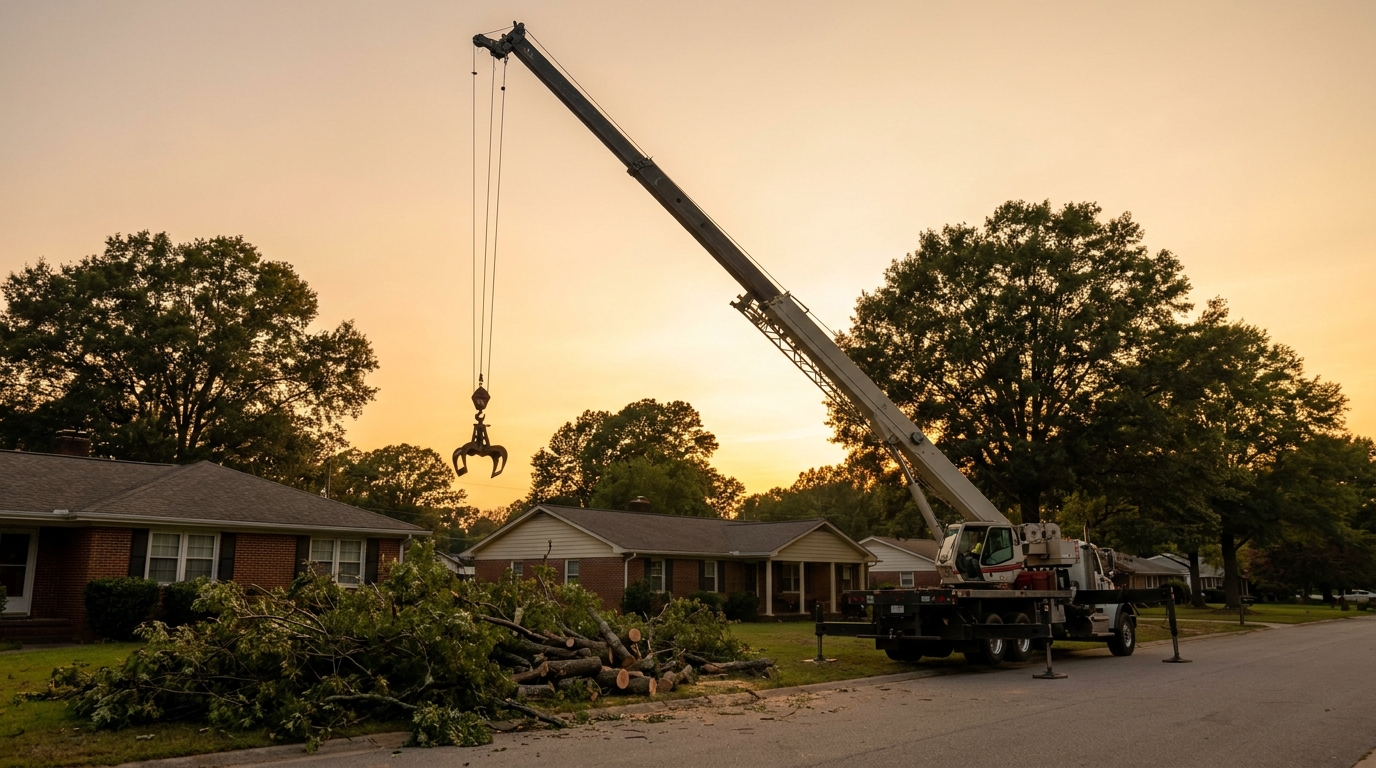
A crane is the right call when a tree is too close to your house, too dead to climb, or too big to drop in the space available. Crane-assisted tree removal lifts each section straight up and away from your roof instead of dropping it near your foundation. It is usually faster, almost always safer, and often costs less than repairing what a failed drop can damage.
Most of Raleigh was built into an existing pine canopy. That means thousands of homes in Wake County sit directly under mature loblolly pines and willow oaks that were full grown before the house existed. When one of those trees has to come down, the space to work with is measured in feet, not yards, and a single misjudged drop can take out a roofline, a fence, a car, or a gas meter.
That is exactly the situation a crane is built for. From tight backyard lots in North Raleigh to steep wooded properties out toward Wake Forest, our certified arborists in Raleigh use crane-assisted removal to take the tree apart in controlled lifts, with nothing swinging toward the house.
When You Need Crane-Assisted Tree Removal in Raleigh
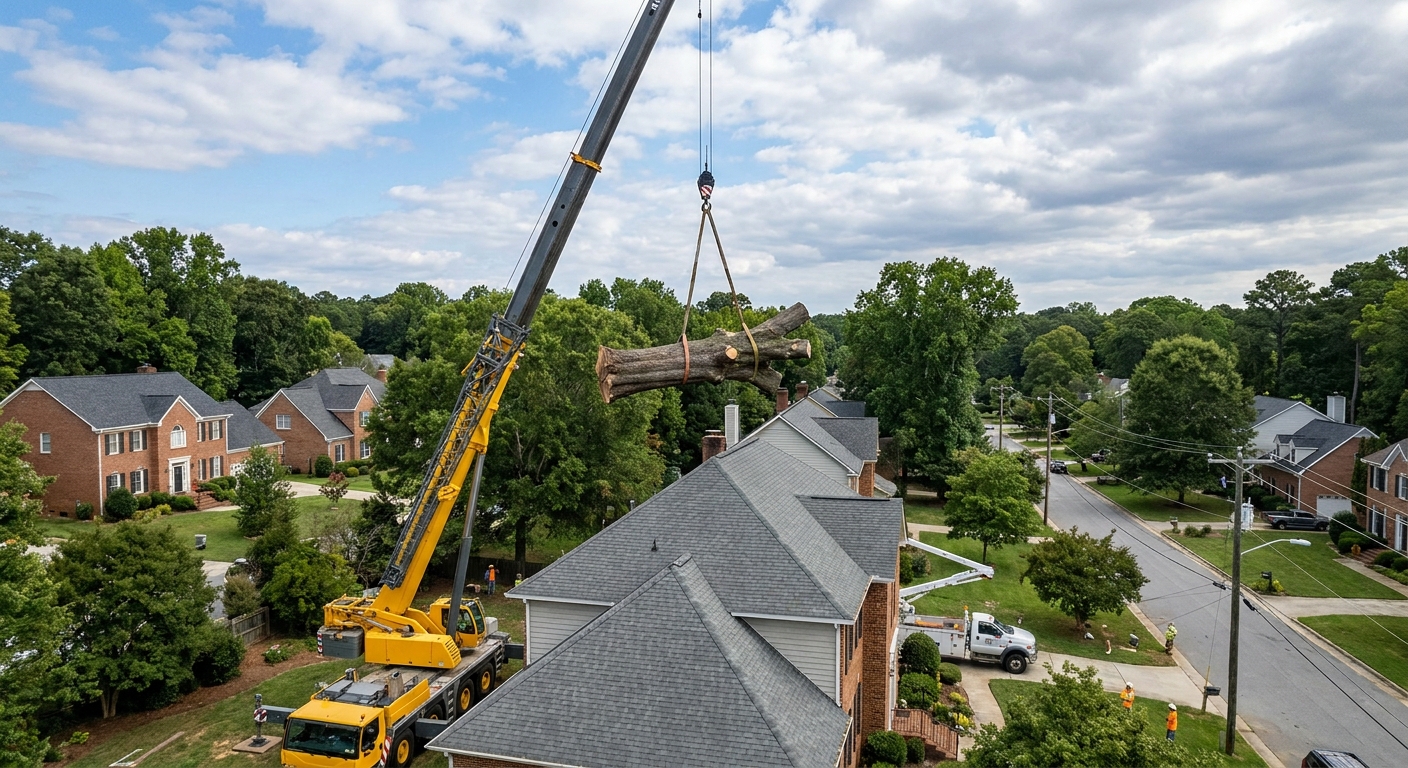
Not every tree needs a crane, and most do not. A crane earns its place when the fall zone is compromised, when the wood itself cannot be trusted, or when there is simply nowhere safe to put a falling limb. Our certified arborists make that call on-site, before any equipment is scheduled. Here is when we bring the crane out.
- The tree overhangs the house. If limbs sit above your roof, sunroom, or garage, there is no safe direction to drop them. The crane lifts them off instead.
- The tree is dead or decayed. Dead wood is unpredictable. Climbing a tree with internal decay puts a person inside a structure that can fail under their weight, so we lift the climber’s risk out of the equation entirely.
- The trunk is split, leaning, or the root plate is lifting. A compromised trunk can barrel or twist the moment weight shifts. A crane holds each piece before the cut is finished.
- Access is blocked. Narrow side yards, privacy fences, septic fields, and neighbouring pools all remove the option of dropping wood where it lands.
- The tree is very large. Mature loblolly pines in Raleigh regularly run 80 to 100 feet. At that height, sectional rigging alone can put thousands of pounds of shock load into anchor points.
- Multiple trees are coming out at once. On wooded lots a crane turns several days of climbing into a single controlled day of picks.
Safety drives every one of those decisions. If a tree can be climbed and dropped safely, we will tell you so and quote it that way.
Is a Tree Leaning Toward Your House?
Our certified arborist will come out, assess the lean, the root plate, and the fall zone, and tell you honestly whether it needs a crane or not.
How Crane Tree Removal Works, Step by Step
Crane tree removal looks dramatic from the street, but on site it is slow, deliberate, and heavily planned. Here is what actually happens on a Raleigh property, from the first walk-through to the final rake.
Step 1: Site Assessment and Crane Placement
We walk the property and decide where the crane can legally and safely sit. That means checking the driveway load rating, the septic field, the water meter, and every overhead utility line in reach. Placement decides everything, because a crane set ten feet off can turn an easy pick into an impossible one.
Step 2: Setting the Outriggers
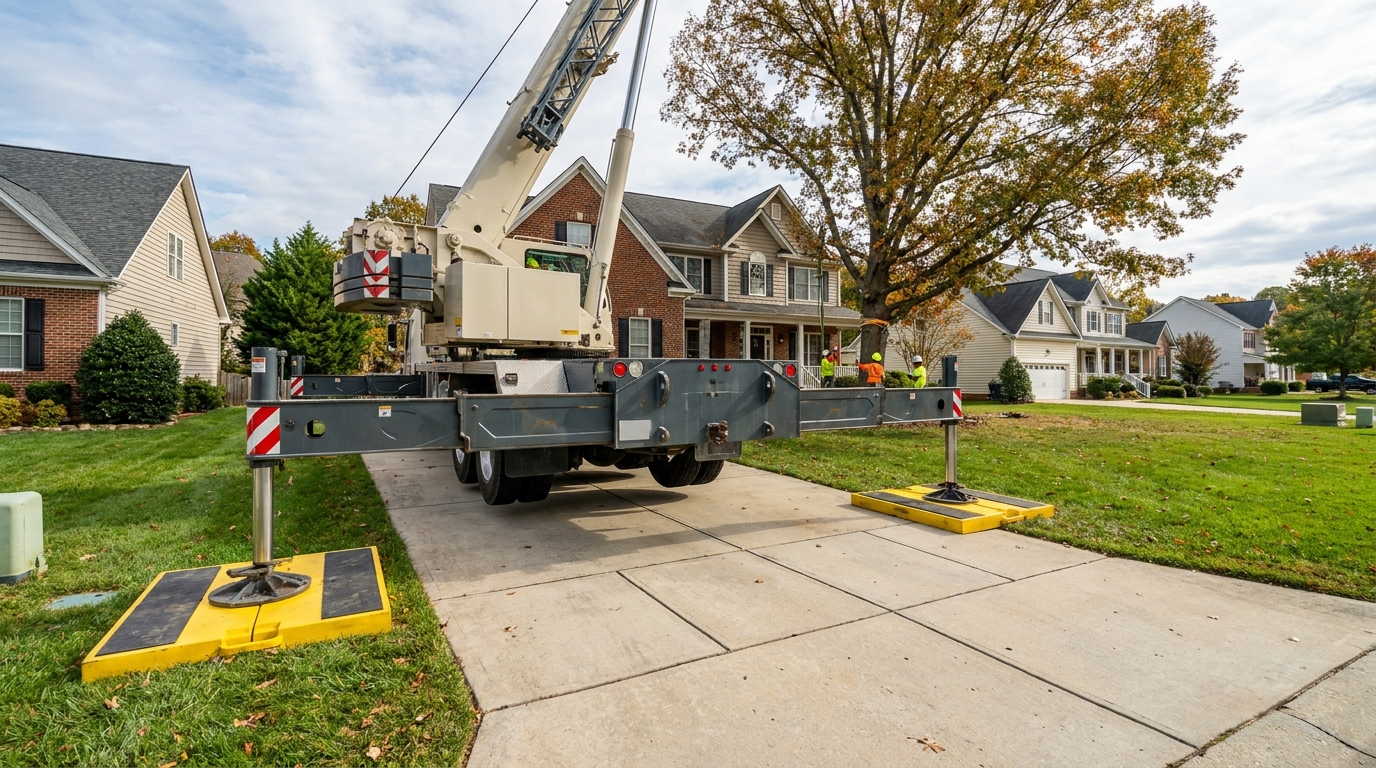
The crane extends outriggers and lifts its own weight off the tyres, and we put load pads under every foot to spread the pressure and protect driveways and lawns. This is the step that protects your hardscaping, and skipping it is how driveways crack.
Step 3: Rigging the First Pick
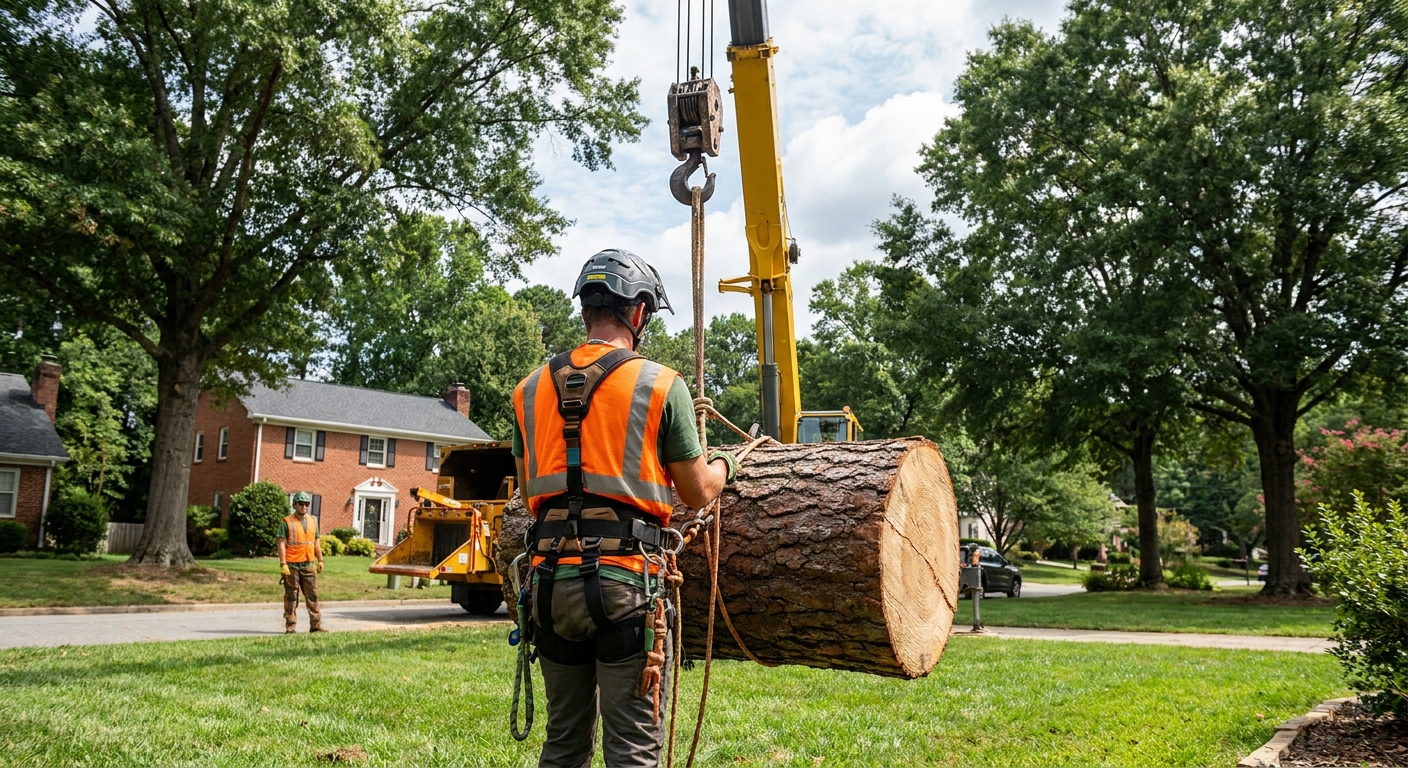
A climber or bucket operator attaches the crane’s rigging to the section being removed, and the crane takes up the tension before a single cut is made. By the time the saw goes through, the crane is already carrying the weight, so nothing drops.
Step 4: The Lift
The cut section is lifted straight up, clear of the roof and the canopy, then swung out to a drop zone away from the structure. Each pick is weighed against the crane’s load chart at that radius, and whether the piece is a 400 pound limb or a 6,000 pound trunk section, it is calculated before it leaves the tree.
Step 5: Processing, Stump and Cleanup
Sections are cut down at the drop zone, run through the chipper, and hauled out. If you want the stump gone as well, our stump grinding crew grinds it below grade and fills the void. Then we rake, blow the beds, and clear the street, because we leave your property looking better than it was when we arrived.
Crane Tree Removal Cost in Raleigh: What Drives the Price
This is the question we get first, and most websites dodge it, so here is a straight answer. Crane tree removal is priced on the whole job, not by the hour of crane time, and two trees of identical height on two different Raleigh properties can differ by thousands of dollars based on access alone. These are the factors that move the number.
| Factor | Why it changes the price |
|---|---|
| Crane setup distance | The further the crane sits from the tree, the less it can safely lift at that radius. A longer reach can mean a bigger crane. |
| Tree size and wood density | A 90 foot loblolly pine and a 60 foot willow oak can weigh the same. Oak is far denser, so it needs more picks. |
| Condition of the tree | Decayed wood cannot be rigged conventionally and needs smaller, more cautious picks. |
| Obstacles in the swing path | Power lines, pools, sheds and neighbouring roofs all restrict where a section can travel. |
| Debris volume and haul-off | A mature oak can produce several truckloads of chip and log. That is labour and disposal. |
| Stump grinding | Optional, and usually quoted as a separate line so you can decide. |
| Emergency or after-hours work | Storm response is mobilised immediately, which carries a different rate than scheduled work. |
Here is the part worth understanding. Homeowners often assume the crane is the expensive option, and often it is the opposite. A crane can cut a two day climbing job down to a single day, and one day of crew time frequently costs less than two. It also removes the risk of a dropped section putting a hole in a roof, which is the outcome nobody budgets for.
We will not quote a crane removal sight unseen, and you should be cautious of anyone who does. Every estimate we give is free, on-site, and written down before any work starts.
Want to Know What Your Tree Will Cost?
Book a free, no-obligation site visit. Our certified arborist walks the property with you, tells you whether it needs a crane, and puts the price in writing before anything starts.
★★★★★
“We had a couple of large dead trees on a property we recently purchased. I called and they came to give a quote the next day, and the following day they removed the trees. The whole team was amazing and managed to get the job done in a couple of hours with no damage to my home, even though the trees were very close.”
Jack G., Raleigh, NC · Verified Google Review
Raleigh Tree Species That Most Often Need a Crane
Local knowledge matters here. The Triangle’s canopy is dominated by a handful of species, and each fails in its own way. These are the trees we most often end up lifting out rather than climbing.
| Species | Typical mature height | Why it often needs a crane |
|---|---|---|
| Loblolly pine | 80 to 100 ft | Tall, top-heavy, shallow rooted. Snaps in wind and leans after saturated ground. |
| Willow oak | 60 to 80 ft | Enormous spreading canopy planted close to older Raleigh homes. Dense, heavy wood. |
| Sweetgum | 60 to 75 ft | Brittle limbs that shed in storms, frequently over driveways and fences. |
| Southern magnolia | 40 to 60 ft | Very heavy for its height, with low branching that blocks a clean drop. |
| Water oak | 50 to 80 ft | Prone to internal decay well before it shows outside, so climbing is a gamble. |
Water oak deserves a specific warning. It is one of the most common trees in older Raleigh neighbourhoods and one of the most deceptive, and NC State Extension notes its tendency toward a short life and early decline. A water oak can look full and healthy while the trunk is hollow, so if you are unsure what is standing in your yard, our guide on how to tell if a tree is dead walks through the warning signs you can check from the ground.
Crane Tree Removal vs Traditional Climbing: Which Is Safer
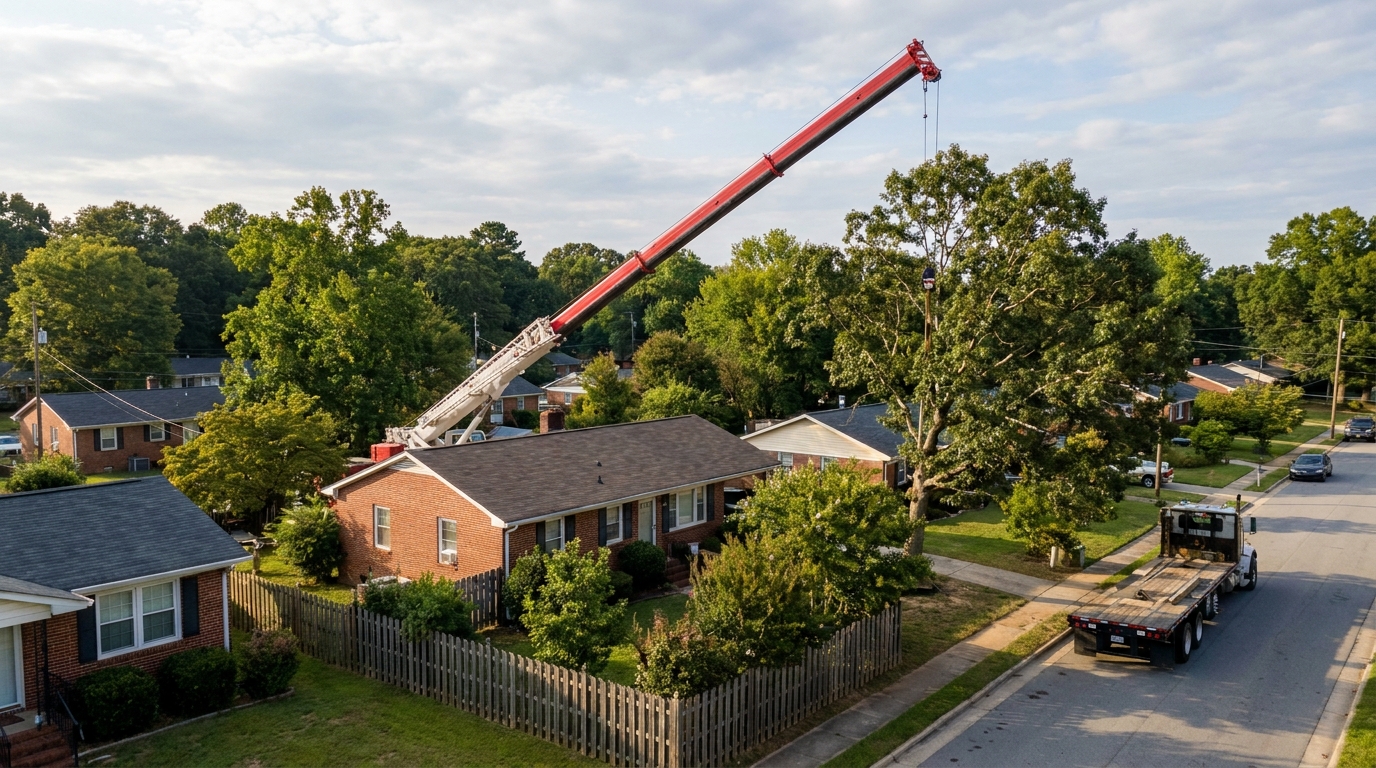
Both methods are legitimate, and the right one depends entirely on the tree and the space around it. This is how we weigh it up.
| Consideration | Crane-assisted removal | Traditional climbing |
|---|---|---|
| Dead or decayed wood | Safest option. No one is inside the failing structure. | High risk. The climber depends on the wood holding. |
| Limbs over the roof | Lifted clear vertically. | Possible with rigging, but every piece swings. |
| Time on site | Usually one day. | Often two or more on large trees. |
| Lawn and driveway impact | Concentrated at the outrigger points, managed with pads. | Spread out, but more dragging across the lawn. |
| Very tight rear gardens | Depends on reach. Sometimes the crane cannot see the tree. | Often the only workable method. |
A crane is not automatically the answer. On a small backyard tree with clear ground beneath it, sending a climber up with a bucket truck is faster and cheaper, and we will say so. Whether the job calls for a crane, a bucket truck, a spider lift, or a grapple saw, the equipment decision is made on safety first, and that is the same standard we apply to structural pruning and to full tree removal in Raleigh.
If the Tree Is Already Down or Actively Failing
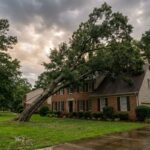
Everything above assumes you have time to plan, and sometimes you do not. If a tree has already come down on your house, is resting against the structure, or has a visibly lifting root plate, that is no longer a scheduled job. Emergencies don’t wait for business hours, and neither do we.
Call immediately, do not wait for a quote, if:
- A tree or large limb is resting on your roof, garage, or vehicle
- A tree is touching or leaning into a power line
- The root plate is lifting out of the ground on one side
- You can hear cracking from the trunk
- A large limb is hanging above a walkway, driveway, or play area
For a tree that is already down or immediately dangerous, go straight to our 24/7 emergency tree service in Raleigh. We keep the crane and the crew available around the clock for exactly these calls, and we serve the whole Triangle for emergency work, from Knightdale and Garner through to tree service in Cary and Apex.
Frequently Asked Questions About Crane Tree Removal in Raleigh
How much does crane tree removal cost in Raleigh?
It depends on the size of the tree, how far the crane has to sit from it, and what is in the swing path. A straightforward pine near the driveway and a hollow oak behind a fenced pool are completely different jobs. We do not quote crane work over the phone, because the setup position is what drives the price and we have to see it. The estimate is free and we put it in writing before anything starts.
Can a crane pull a tree out of the ground, roots and all?
No, and anyone offering to do that is risking your property. Cranes are rated to lift vertically, not to tear against the resistance of a root plate. Pulling sideways puts the load outside the crane’s chart and can tip the machine. We remove the tree in sections, then grind the stump out separately.
Will the crane damage my driveway or lawn?
Not when it is set up properly. We put load-spreading pads under every outrigger foot, which distributes the weight instead of concentrating it on four points. On soft ground we also mat the travel path. Some lawn compression at the outrigger positions is normal and recovers, and we tell you where that will be before we set up.
How long does crane tree removal take?
Most single-tree crane removals in Wake County are a one day job, including chipping and cleanup. Setting up and breaking down the crane takes a meaningful part of that day. If we are taking several trees off the same setup position, we can often do them all in the same visit, which is why removing three at once costs far less per tree than three separate calls.
Do I need a permit to remove a tree in Raleigh?
For most trees inside a private residential yard in Raleigh, no permit is needed. It changes if the tree sits in a protected area, a tree conservation area, a right of way, or on a commercial site, and some HOAs have their own rules on top of the city’s. We check the situation as part of the estimate, and if a permit is required we will tell you before we schedule.
Does homeowners insurance cover crane tree removal?
Generally only when the tree has damaged something insured. If a pine comes through your roof, removal is usually part of the claim. If the same pine is simply dead and you want it gone before it falls, that is normally maintenance and comes out of your pocket. Check with your carrier, and take photographs before anything is moved.
Is a crane safer than climbing the tree?
For a dead or decayed tree, considerably. Climbing means putting a person inside a structure that is already failing, and relying on that wood to hold their weight and their anchor points. A crane keeps the climber’s exposure short and controls every section before the cut finishes. For a healthy tree with clear ground under it, climbing is perfectly safe and usually the better value.
Do you need access to my neighbour’s property to use a crane?
Usually not. In most Raleigh setups the crane sits in your driveway or on the street and reaches over the roofline. If the only viable position is next door, we will tell you at the estimate and it is your call whether to ask them. We never set foot on a neighbouring property without their explicit permission.
Can you get a crane out same day after a storm?
For genuine emergencies, yes, and that is what the 24/7 line is for. After a large storm the whole Triangle calls at once, so we triage by danger. A tree on a house or against a power line goes to the front of the queue ahead of a limb down in the yard. Call (984) 328-3971 and tell us exactly what is touching what.
I am Steve, and I own Ashland Tree Service. A tree close to the house is not automatically an emergency and not automatically a crane job, and the only way to know is to have someone qualified stand under it and look properly. Call me directly at (984) 328-3971 or book a free estimate, and I will come out and assess it personally with no obligation and no pressure. If it can be climbed safely, I will quote it that way and save you money. And we leave your property looking better than it was when we arrived.