Short version
In North Carolina, when a healthy tree falls in a storm, each property owner normally claims the damage on their own insurance, no matter whose trunk it grew from. Liability shifts to the tree’s owner only when that owner knew, or reasonably should have known, the tree was already dangerous and did nothing about it. That single word, negligence, is what decides who pays.
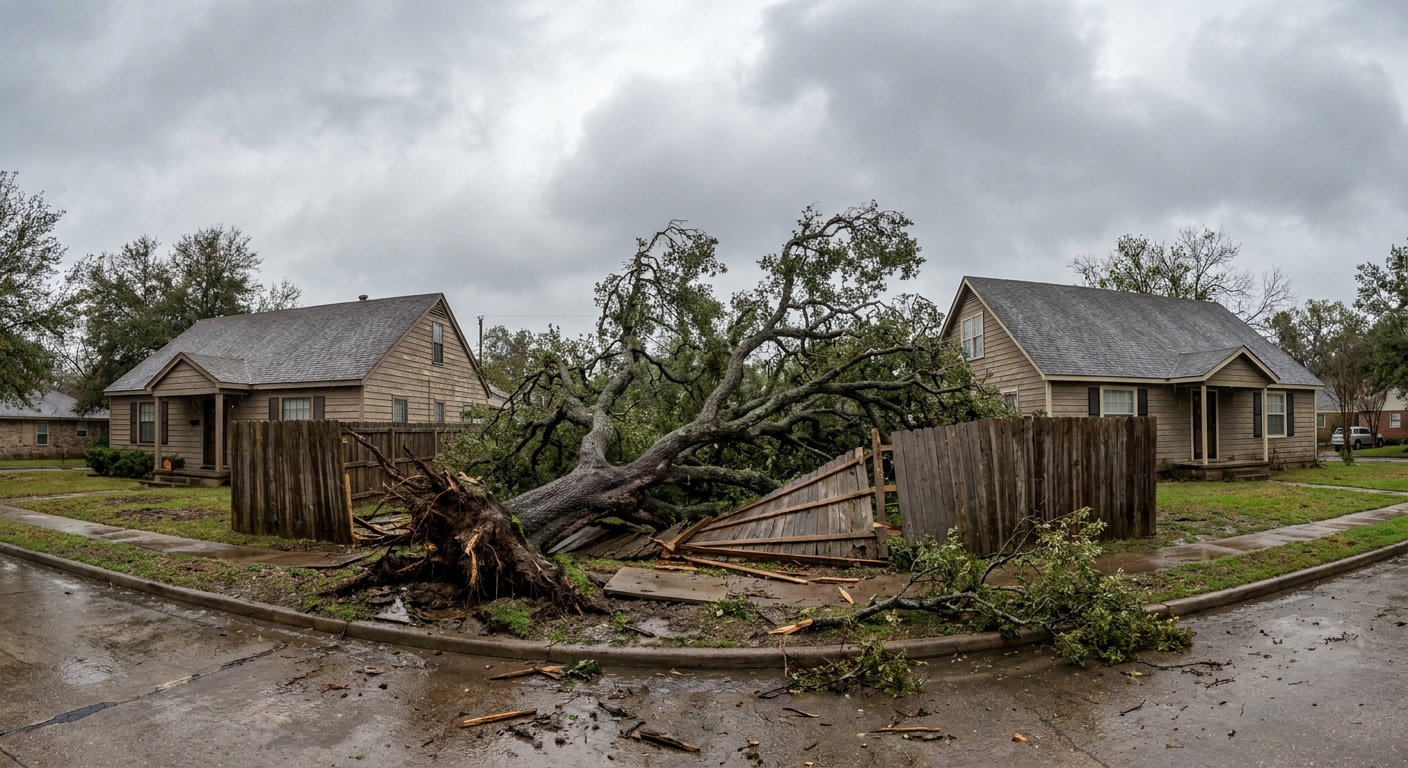
It is one of the most common calls we get after a Wake County storm. A pine or a willow oak has come down across a fence line, part of it is on one property and part on another, and two neighbours are standing in the yard trying to work out whose problem it is.
The honest answer is that it depends on the condition of the tree before it fell, not on where the trunk was rooted. That surprises most homeowners, and it is the single most useful thing to understand before you call anyone. Our certified arborists in Raleigh deal with this exact situation constantly, and the pattern almost never changes.
Please note: This guide explains how tree liability generally works in North Carolina so you know what questions to ask. It is general information from an arborist, not legal advice. For a disputed claim or a significant loss, speak to a North Carolina attorney or your insurance carrier.
Who Is Responsible When a Tree Falls in North Carolina?
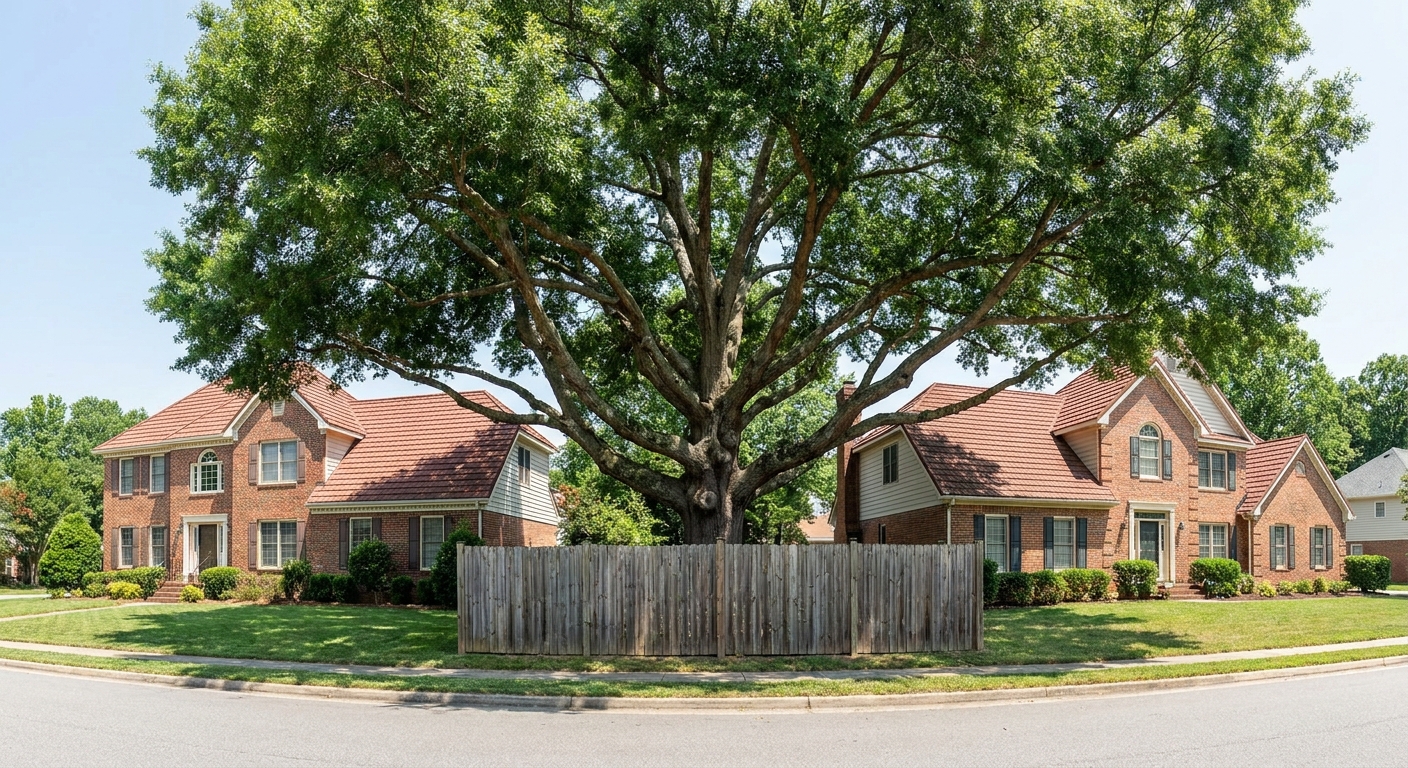
Start with the rule that catches everyone out. In North Carolina, responsibility for a fallen tree does not automatically follow ownership of the tree, and the property line is not the deciding factor most people assume it is.
The default position is that a healthy tree brought down by wind, saturated ground, or lightning is treated as an act of nature. When that happens, each owner turns to their own homeowners policy for the damage on their own side of the line, and neither neighbour owes the other anything. This feels unfair to the person whose roof took the hit, but it is the standard outcome across most of the state.
The picture changes completely when the tree was already failing. If the owner knew the tree was dead, diseased, split, or visibly leaning, and had been told or could plainly see it, then letting it stand can amount to negligence. In that situation the tree’s owner and their liability coverage can be on the hook for the damage it caused next door.
Worried About a Tree on Your Property Line?
Our certified arborist will inspect it, tell you honestly whether it is a hazard, and put that assessment in writing so you have a record.
Act of Nature or Negligence: The Line That Decides Who Pays
Every dispute we see comes down to this one distinction, so it is worth being precise about it. The question an adjuster or an attorney will ask is not whose tree it was, but whether a reasonable owner should have seen the failure coming.
Here is how the common Raleigh scenarios usually fall out.
| Scenario | Who normally pays | Why |
|---|---|---|
| Healthy pine snaps in a hurricane and hits the neighbour’s roof | The neighbour’s own policy | Act of nature. No one could have predicted it. |
| Obviously dead oak falls on the neighbour’s garage | Potentially the tree owner | The hazard was visible. Failing to act can be negligence. |
| Neighbour sent a written warning months ago, tree then falls | Strong case against the tree owner | Written notice removes any argument the owner did not know. |
| Tree straddles the boundary and falls | Usually shared | A boundary tree is generally treated as jointly owned. |
| Tree falls and damages nothing, just lands in the yard | The owner of the land it lands on | With no damage to a structure, most policies will not pay to clear it. |
| Tree falls onto a parked car | The car owner’s comprehensive cover | Vehicle damage sits with the auto policy, not the home policy. |
That fifth row is the one that stings. If a neighbour’s healthy tree drops into your yard and hits nothing, you will usually be paying for the removal yourself, which is exactly the outcome nobody expects.
Need a Hazard Tree Assessed Before It Becomes a Dispute?
Book a free, no-obligation site visit. Our certified arborist inspects the tree, documents its condition in writing, and tells you exactly what it needs before the next storm arrives.
Signs a Tree Was Already Hazardous Before It Fell
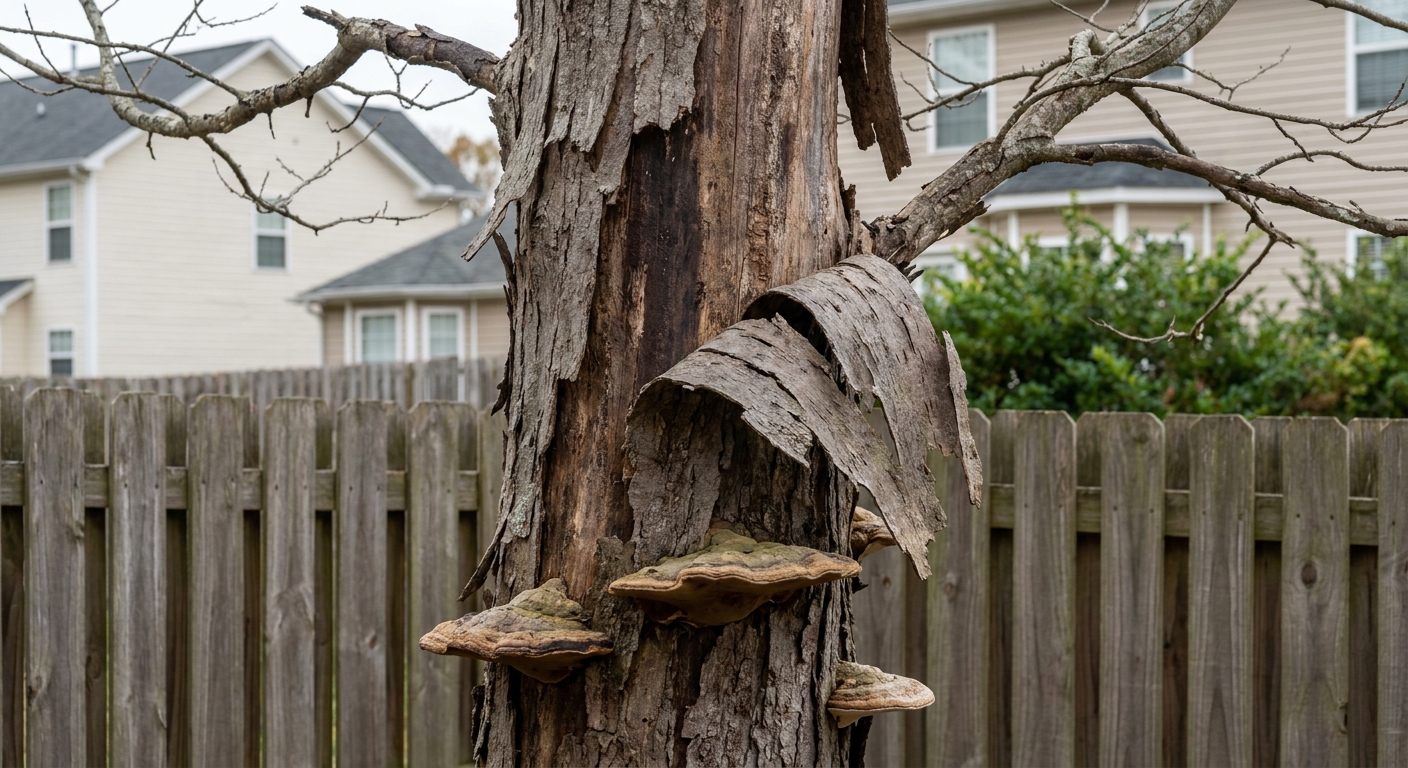
Because negligence turns on what the owner should have noticed, the physical condition of the tree becomes the evidence. These are the warning signs that an arborist, an adjuster, or an attorney will point to, and every one of them is visible from the ground without climbing anything.
- Mushrooms or bracket fungi at the base. Fungal growth on the root flare usually means the wood inside is already decaying, and it is the clearest single indicator of internal failure.
- Bark falling away in sheets. A living tree holds its bark. Large bare patches mean that section is dead.
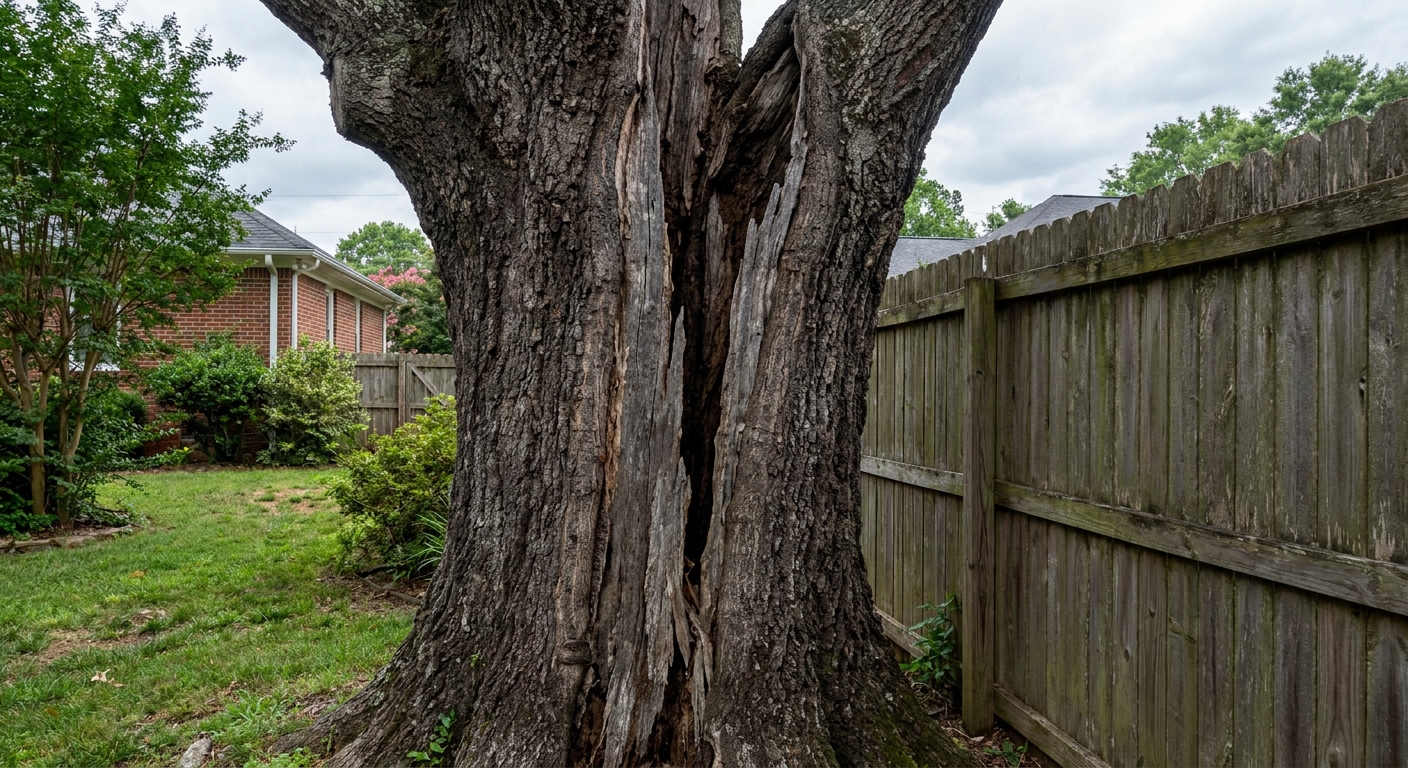
- A visible crack or seam running down the trunk. Vertical splits mean the trunk has already partially failed and is being held together by very little.
- A lean that has changed. Trees can grow at an angle safely for decades. A lean that is new, or has increased after heavy rain, is a different matter entirely.
- Soil lifting or cracking on one side of the base. This means the root plate is moving, and it is the most urgent sign on this list.
- Dead limbs in the upper canopy. A crown that is thinning or holding bare branches while the rest of the street is in full leaf points to a tree in decline.
- Carpenter ants or sawdust around the roots. Insects follow decay, so they are a symptom of a problem that started earlier.
If you can see two or more of these on a tree near a boundary, treat it as a live issue rather than something to watch. Our guide on how to tell if a tree is dead goes through each of these signs in more detail with what to look for.
★★★★★
“Prompt and thoughtful they helped us during an emergency tree removal. Two trees fell against our fence and were leaning toward our neighbors house. They came first thing in the morning. They removed 5 dead trees in addition to the 2 trees leaning against the fence. All 7 trees represented a threat to our neighbors house and our own house. What a relief to see the trees go down safely, get cut up and hauled away by 1 PM.”
Jerry C., Raleigh, NC · Verified Google Review
Who Is Responsible for Cutting Overhanging Tree Branches?
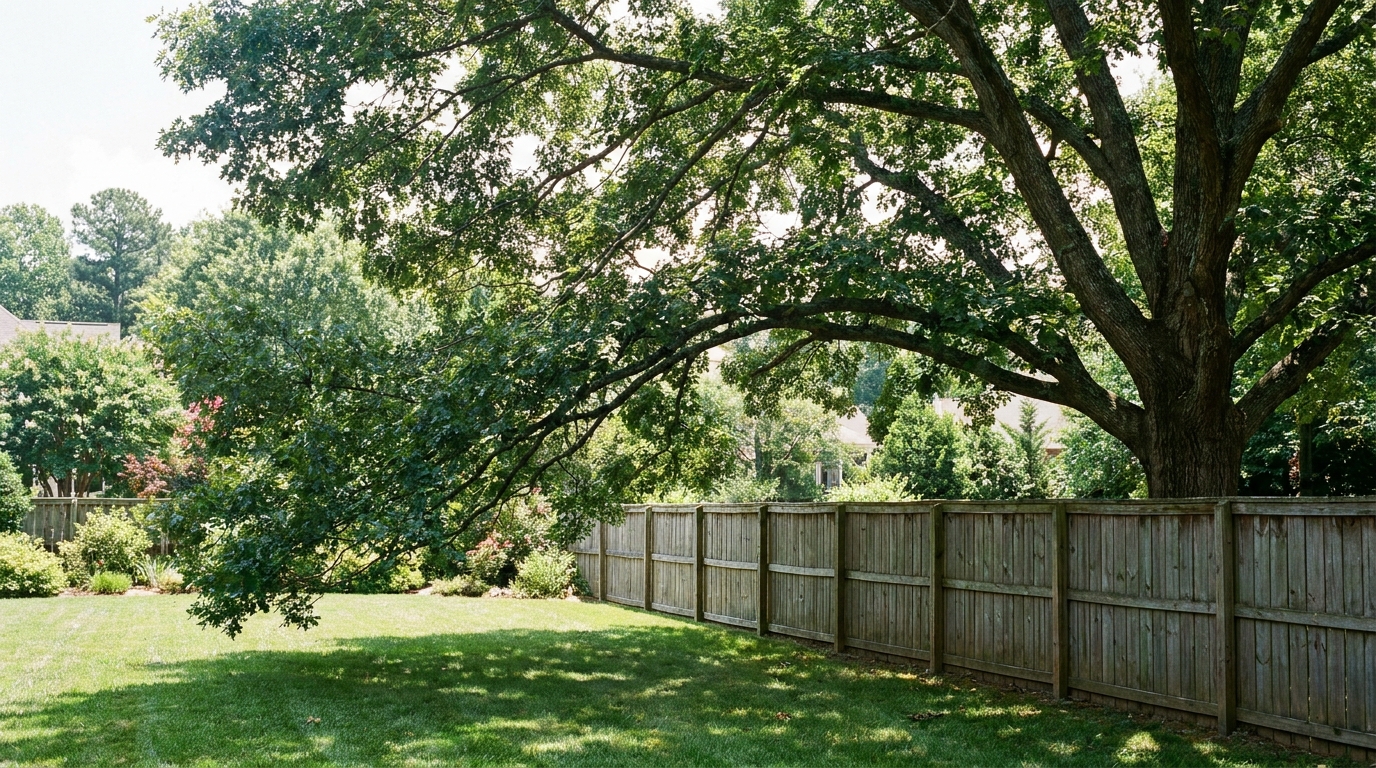
This is the most searched question in the whole topic, and the answer in North Carolina is more generous to the neighbour than most people expect. If branches from next door hang over your property, you are generally allowed to cut them back to the property line yourself, at your own expense, without asking permission.
The limits on that right matter just as much as the right itself. You cannot cross onto your neighbour’s land to make the cut, you cannot cut beyond the boundary, and you cannot prune so severely that you kill or destabilise the tree. Doing any of those things can turn you from the wronged party into the liable one, and North Carolina takes damage to another person’s tree seriously.
The same principle covers roots that cross the line. You may cut roots on your side, but severing major structural roots can destabilise the whole tree, and if it then falls, you may have created the very liability you were trying to avoid. Before taking a saw to anything on a boundary, it is worth having a professional look at what removing that material will do to the tree, which is part of what our tree trimming service in Raleigh assesses before any cut is made.
What to Do in the First 48 Hours After a Tree Falls
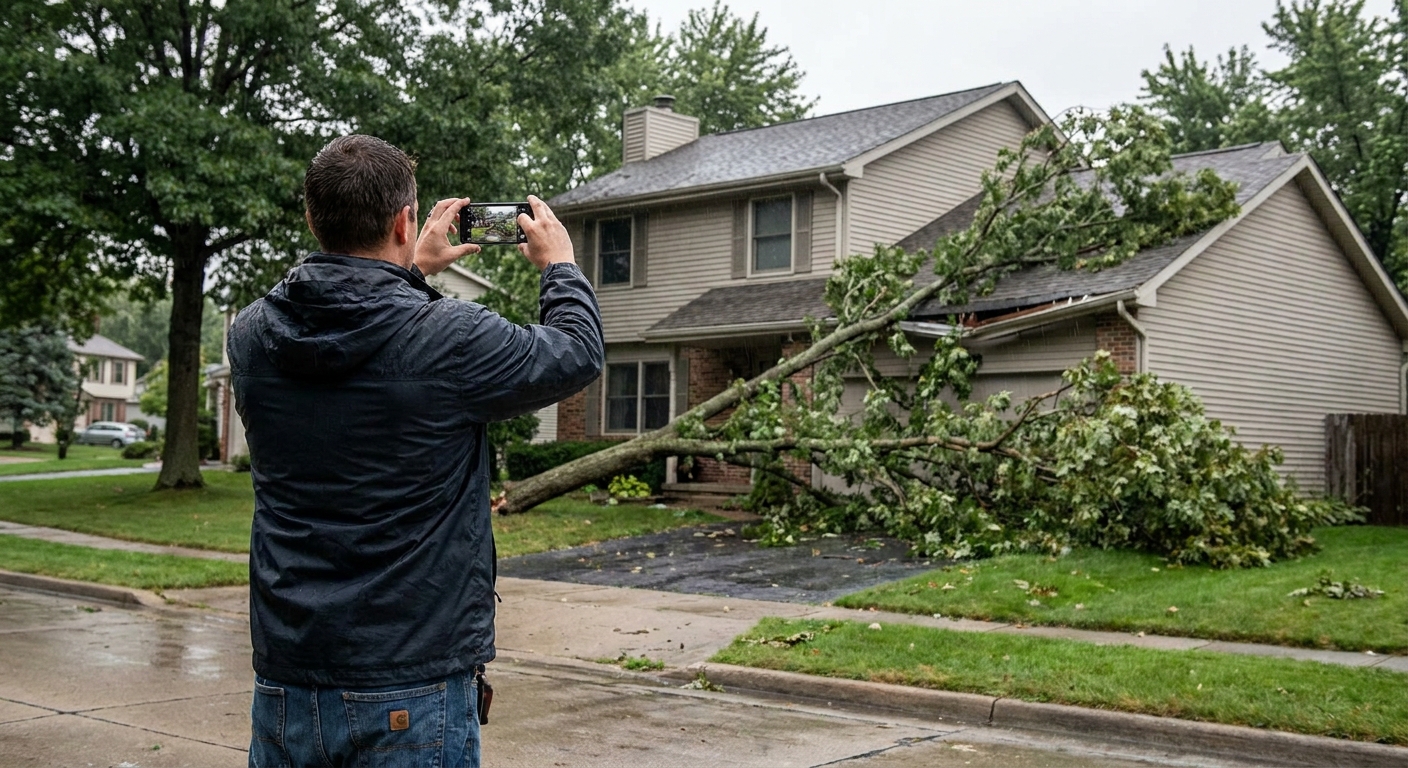
What you do in the first two days shapes how the claim goes, and most of it costs nothing. Work through these in order.
- Make sure everyone is safe and stay away from lines. If the tree is touching a power line, treat the ground around it as live, keep everyone back, and call the utility before anyone else.
- Photograph everything before anything moves. Wide shots showing the whole scene, close-ups of the base, the root plate, the break point, and any decay visible inside the broken wood.
- Photograph the stump and the interior of the trunk. If the wood is hollow, dark, or crumbling inside, that is the evidence that the tree was failing before the storm, and it disappears the moment the wood is chipped.
- Call your own insurer first. Report it on your own policy even if you believe the neighbour is at fault. Carriers sort liability between themselves afterwards through subrogation.
- Make the site safe, but keep the evidence. Emergency work to prevent further damage is normally covered and expected. Ask the crew to leave the stump and a trunk section intact where possible.
- Keep every receipt. Tarps, board-up materials, emergency removal, temporary accommodation. All of it may be recoverable.
- Put any communication with the neighbour in writing. A short text or email creates a dated record, which is far more useful later than a conversation over the fence.
If the tree is on a structure, across a driveway, or resting against the house, that is an emergency and it should not wait for a scheduled appointment. Our 24/7 emergency tree service in Raleigh handles exactly these calls, and we work around the documentation rather than through it, so your claim stays intact.
Does Homeowners Insurance Cover Tree Removal in North Carolina?
This is where expectations and policies part company most often. Homeowners insurance is built around damage to insured structures, not around trees, and that distinction explains almost every surprise on a claim.
The general shape of it looks like this, though every policy differs and your own declarations page is the only authority that matters.
| Situation | Typically covered? |
|---|---|
| Tree hits your house, garage, or fence | Yes, repair plus removal of the tree from the structure |
| Tree falls in the yard and hits nothing | Usually not, this is normally the owner’s cost |
| Tree blocks your driveway or a disability ramp | Often yes, many policies make an exception for access |
| Dead tree you want removed before it falls | No, preventative removal is treated as maintenance |
| Tree lands on your parked car | Under auto comprehensive cover, not the home policy |
| Debris haul-away after a covered loss | Usually yes, but often capped at a set amount per tree |
That fourth row is the one worth acting on. Insurance will pay to clean up after a dead tree destroys something, and will not pay to take the same tree down safely beforehand, which means the cheapest moment to deal with a hazard is always before it fails. Planned tree removal in Raleigh costs a fraction of a roof repair, and it also removes the negligence question entirely.
Can You Force a Neighbour to Remove a Dangerous Tree?
This comes up whenever someone has been watching a dead pine lean toward their bedroom for two years. The blunt answer is that you cannot go onto their land and take it down, and doing so exposes you to a serious claim for damaging their property.
What you can do is build the record that shifts the risk onto them. Send a dated written notice describing exactly what you can see, keep a copy, and where the hazard is significant, pay for a written arborist assessment and send that too. Once an owner has been formally told their tree is a hazard by someone qualified, the act of nature defence becomes very hard for them to run if it later fails.
If the tree threatens a public street or sidewalk rather than just your yard, the City of Raleigh or your local code enforcement office may take an interest, and that is worth a call. Beyond that, the route is a civil one, and most people find that a written arborist report changes a neighbour’s mind long before a lawyer needs to.
Tree Roots, Foundations, and Sewer Lines: Who Is Liable?
Roots follow the same self-help logic as branches, with one important practical difference. You are generally entitled to cut roots that cross onto your land, but roots are structural, and severing the wrong ones can bring the whole tree down onto whoever is standing nearest.
Damage claims for roots are much harder to win than damage claims for a fallen trunk. Courts tend to treat encroaching roots as something the affected owner can deal with themselves rather than something the tree’s owner owes money for, unless there is clear negligence involved. In practice that means the cost of the repair usually lands with the property that suffered it.
Before cutting anything larger than a wrist near a foundation or a service line, get the tree assessed. Removing a significant lateral root on one side is one of the most common ways a stable tree becomes an unstable one, and the failure often does not happen until the next storm.
Common Myths About Tree Liability in North Carolina
These four come up in almost every conversation, and every one of them is wrong.
- “It was their tree, so it is their problem.” Ownership of the trunk does not decide it. The condition of the tree before it fell decides it.
- “They have to pay because it landed on my side.” Not for a healthy tree in a storm. That is your own policy, and often your own deductible.
- “I can cut the whole overhanging limb off at the trunk.” You can cut to the boundary line and no further. Cutting past it, or killing the tree, turns the liability around.
- “Insurance will pay to take the dead tree down before it falls.” It will not. Preventative removal is maintenance, and it comes out of your pocket every time.
The through line in all four is the same. Waiting for a tree to fail is the expensive option, and dealing with it while it is still standing is the cheap one.
Frequently Asked Questions About Tree Liability in North Carolina
If my tree falls on my neighbour’s house in NC, am I responsible?
Only if the tree was already in a condition you knew about or should have noticed. A healthy tree brought down by a storm is normally an act of nature, and your neighbour claims on their own policy. A dead or visibly failing tree is a different matter, and if you had been warned or the decay was obvious, you can be held liable for the damage.
Who is responsible for cutting overhanging tree branches in North Carolina?
You can generally cut branches that cross onto your property back to the boundary line, at your own cost, without your neighbour’s permission. You cannot enter their land to do it, cut past the line, or prune so hard that the tree dies or becomes unstable. If the branch is large or high, get it done properly, because a bad cut that kills the tree can make you the liable party.
My neighbour’s tree fell on my house. Do I claim on their insurance or mine?
Start with your own carrier, even when you are confident the neighbour was negligent. Your insurer will get the repair moving, then pursue their insurer directly through subrogation if the evidence supports it, and if they recover you can often get your deductible back. Waiting for the neighbour to accept fault first is what leaves roofs open through the next rain.
Does homeowners insurance cover tree removal in North Carolina?
Generally only when the tree has damaged something the policy insures, such as the house, the garage, or a fence. If it falls in open lawn and hits nothing, most policies will not pay to clear it. Debris removal after a covered loss is usually included, though it is often capped per tree, so check the limit on your declarations page rather than assuming.
Who is responsible for removing a fallen tree that hit nothing?
Whoever owns the land it is lying on, in almost every case. Once a tree is down it is treated as debris on your property, regardless of which side of the fence it grew on. It is the least popular answer in this entire guide, and it is also the most consistent one.
A tree fell on my car. Who pays for that?
Your auto policy, provided you carry comprehensive cover. Home insurance does not extend to vehicles even when the car was parked in your own driveway and your own tree caused it. If the tree belonged to a neighbour and was demonstrably hazardous beforehand, your insurer may pursue theirs afterwards.
A tree is on a power line. Who do I call and who is responsible?
Call the utility first and nobody else, and keep everyone well back, because the ground around a downed line can be energised. The utility handles the line and the portion of the tree touching it, and they do that at no cost to you. No tree crew, ours included, will touch a tree in contact with a live conductor until the utility has released it.
What happens with a tree growing right on the property line?
A tree whose trunk straddles the boundary is generally treated as jointly owned by both neighbours, which means shared responsibility and shared cost. It also means neither owner can remove it unilaterally, and taking one down without the other’s agreement can lead to a serious claim. Get the boundary confirmed and the agreement in writing before any work is scheduled.
How do I prove my neighbour knew their tree was dangerous?
Written notice is what changes the picture, so send a short dated email or text describing what you can see and keep a copy. A written arborist report on the tree’s condition is stronger still, because it establishes the hazard was identifiable by a professional. Photographs of fungal growth, cracks, or a lean, taken with a date on them, back both of those up.
How much will insurance pay toward tree removal?
Debris removal after a covered loss is commonly limited to a set amount per tree with an overall cap per event, and those limits are frequently lower than the real cost of a large crane removal. Get the removal quoted in writing before you agree anything with the adjuster, so the gap is visible from the start. We provide written estimates specifically so they can be handed straight to a carrier.
Can I make my neighbour remove a dead or dangerous tree?
You cannot remove it yourself, and going onto their land to do it would expose you to a claim. What you can do is send dated written notice of what you can see, and back it with a written arborist assessment. Once the owner has been formally told by a professional that the tree is a hazard, they lose the argument that nobody could have known, and most neighbours act at that point.
My neighbour’s tree roots are damaging my foundation. Who pays?
Usually you do, which surprises people. Encroaching roots are generally treated as something the affected owner can cut back themselves rather than a debt owed by the tree’s owner, so repair costs tend to land where the damage happened. Be careful cutting them, because taking out a major structural root on one side is one of the most reliable ways to make a stable tree unstable.
I am Steve, and I own Ashland Tree Service. Almost every neighbour dispute I have walked into over 30+ years could have been avoided by having the tree looked at while it was still standing, because once it is down the argument is about money and before it falls it is just a job. Call me directly at (984) 328-3971 or book a free estimate, and I will come out, tell you honestly whether that tree is a hazard, and give you a written assessment you can show a neighbour or an insurer. And we leave your property looking better than it was when we arrived.