Leaning Trees at a Glance
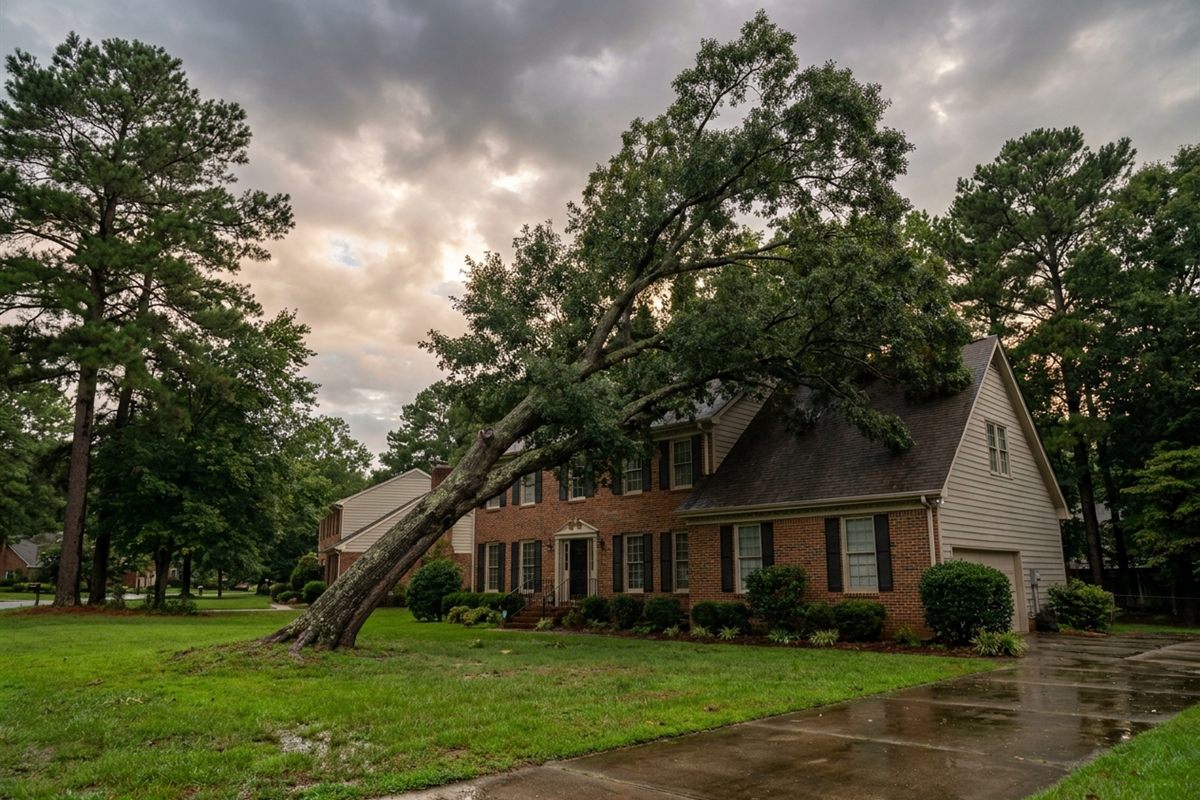
A tree that has leaned the same way for decades has usually grown extra wood to carry that weight, and it is rarely an emergency. A tree that starts leaning suddenly, especially after heavy rain, is a different story, because in Raleigh’s red clay a sudden lean almost always means roots have torn or the soil has let go. Cracked or heaved soil on the side opposite the lean, exposed roots, and a lean pointing at your house are the signs to act on. Keep people out of the fall zone and call a certified arborist, because a large tree with a failing root plate cannot be pulled back upright.
Most of the calls we take about a leaning tree start the same way. A homeowner looks out the back window after a night of storms and realizes the big oak or pine by the fence is not quite where it used to be, or that the lean they have lived with for years suddenly looks worse. Some of those trees are perfectly stable and will stand for another fifty years. Others are one gusty afternoon away from coming through the roof, and from the patio the two can look almost identical.
The difference usually sits at ground level, in the root plate and the soil holding it. Across Raleigh and the rest of Wake County that soil is heavy Piedmont red clay, which behaves in a very particular way when it gets soaked, and that is exactly why so many leaning trees fail in the wet weeks of hurricane season. Our certified arborists have been reading those warning signs in Triangle yards for more than 30 years. Safety is where every one of those assessments starts.
When Is a Leaning Tree Dangerous in Raleigh?
A lean on its own does not make a tree dangerous. Plenty of trees grow toward light, away from a neighboring canopy, or into a steady prevailing wind, and over the years they lay down extra wood on the side that carries the load. That compensating growth lets a tree hold a surprising angle for a very long time. What matters far more than the angle is how long the lean has been there and whether anything at the base has changed.
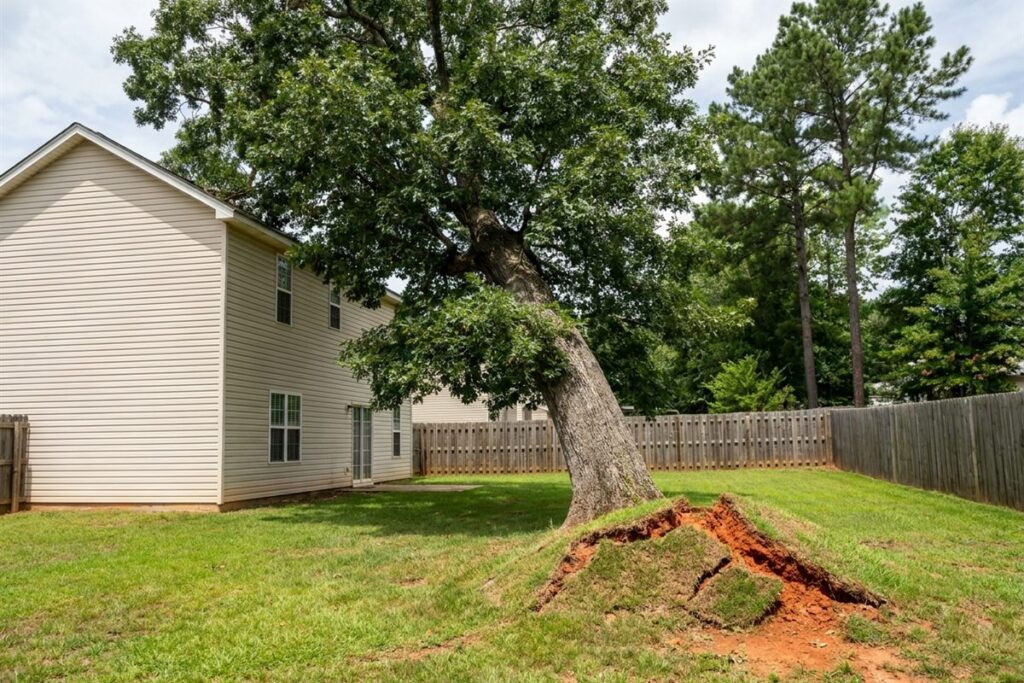
A sudden lean is the one to take seriously. When a tree that stood upright last month is now tilted, the roots on the windward side have usually snapped or pulled loose, and the soil on that side lifts as the root plate rotates out of the ground. That raised, cracked soil opposite the lean is the single most reliable warning sign we know. A tree in that condition has already started to fall, it just has not finished yet.
| What you see | Usually a stable lean | Usually a dangerous lean |
|---|---|---|
| Timing | Has looked the same for years | Appeared or got worse after a storm or a week of rain |
| Soil at the base | Flat and firm all the way around | Raised, cracked or mounded on the side opposite the lean |
| Roots | Buried, with no movement in the lawn | Exposed, snapped, or lifting out of the turf |
| Trunk shape | Curves back upward toward the top | Straight trunk tilted from the ground up |
| Bark and wood | Sound bark, no splits | Vertical cracks, buckled bark on the leaning side, or fungus at the base |
| What it points at | Open lawn or woods | House, driveway, fence, power lines or a play area |
| What to do | Keep an eye on it and recheck after big storms | Keep people clear and call an arborist the same day |
If you are unsure which column your tree belongs in, our free tree risk checker walks you through the main hazard signs in a couple of minutes and gives you a sense of how urgent it looks. It is a sensible first step, but it cannot see the root plate or feel how the soil moves underfoot. For any tree large enough to reach your house, a site visit from a certified arborist is the only way to know it is safe.
Worried About a Leaning Tree Near Your Home?
Our certified arborist will check the root plate, the soil and the trunk, then tell you straight whether that tree can stay. Estimates are free, and there is no obligation to book any work. If the tree has moved in the last few days, call rather than wait for a visit slot.
Why Wake County Red Clay Soil Lets Leaning Trees Uproot After Storms
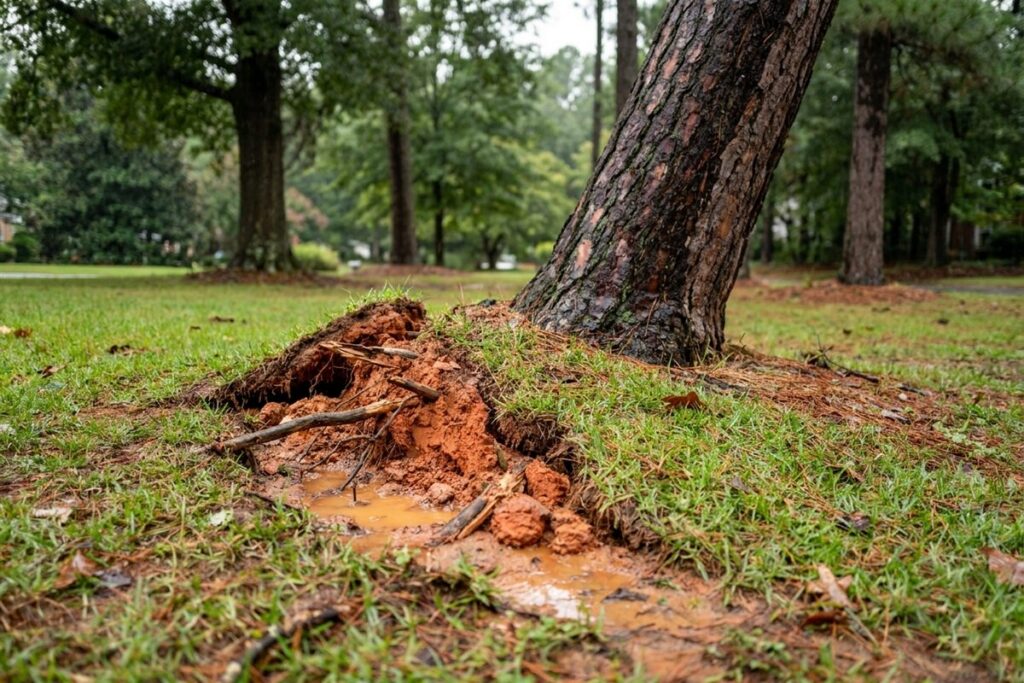
Most of Raleigh sits on Piedmont soil with a thick red clay subsoil, the same Cecil series clay that North Carolina adopted as its official state soil. When it is dry, that clay is hard, dense and very good at holding a tree in place. The trouble is that clay has tiny pore spaces, so water moves into it slowly and drains out of it slowly too. After a few days of steady rain it turns heavy and slick, and a root plate that felt locked in during August can start to slide in September.
Saturated soil is one of the biggest factors in windthrow, which is the term foresters use when wind pushes a tree over roots and all. A tree standing in waterlogged clay has lost much of the friction that anchors it, while its canopy still catches the full force of every gust. Compacted ground makes it worse, and newer lots across Raleigh, Knightdale and Garner often have plenty of compaction left behind by grading equipment. Atlantic hurricane season runs from June 1 to November 30, and the tropical systems that reach the Triangle tend to soak the ground first and bring the wind on top of it.
What loosens a root plate in Triangle clay:
- Several days of soaking rain. Saturated clay loses its grip right when storm winds arrive.
- Construction and trenching. Driveways, patios, irrigation lines and utility trenches cut roots on one side of the tree.
- Compacted ground. Years of vehicles, heavy equipment or foot traffic squeeze the air out of the clay and weaken the root system.
- Poor drainage. Low corners of a yard, downspout outlets and slopes that funnel runoff keep the soil around a trunk waterlogged.
- Decay at the root flare. Mushrooms or soft wood at the base mean the roots themselves may be rotting.
- A big, heavy canopy. Dense crowns on tall pines and oaks act like a sail and put huge strain on a weakened base.
Tall pines are especially prone to this. A mature pine carries most of its weight high up on a long straight trunk, so when the clay around its roots turns soft the force at the base is enormous. We see pines tip after a wet week far more often than we see healthy hardwoods snap in dry weather. If a tree in your yard has started leaning during a stretch of rain, treat it as a moving hazard rather than a curiosity.
After any big storm, walk around the base of your larger trees once the wind has dropped and it is safe to go outside. Look for a crescent-shaped crack in the lawn, turf that has lifted like a lid, roots that were buried yesterday, or a gap opening between the soil and the trunk. Do not stand on the raised side of the root plate or try to stamp it back down. If you find any of those signs on a tree that can reach the house, call our emergency tree service line, because that tree can go over in the next gust.
★★★★★
“Thanks to Ashland tree service our house and kids are safe. They removed several dead leaning trees from property in north Raleigh. We will tell our friends and neighbors.”
Janet T., North Raleigh · Verified Google Review
Tree Leaning Toward Your House in Raleigh: What to Do Next
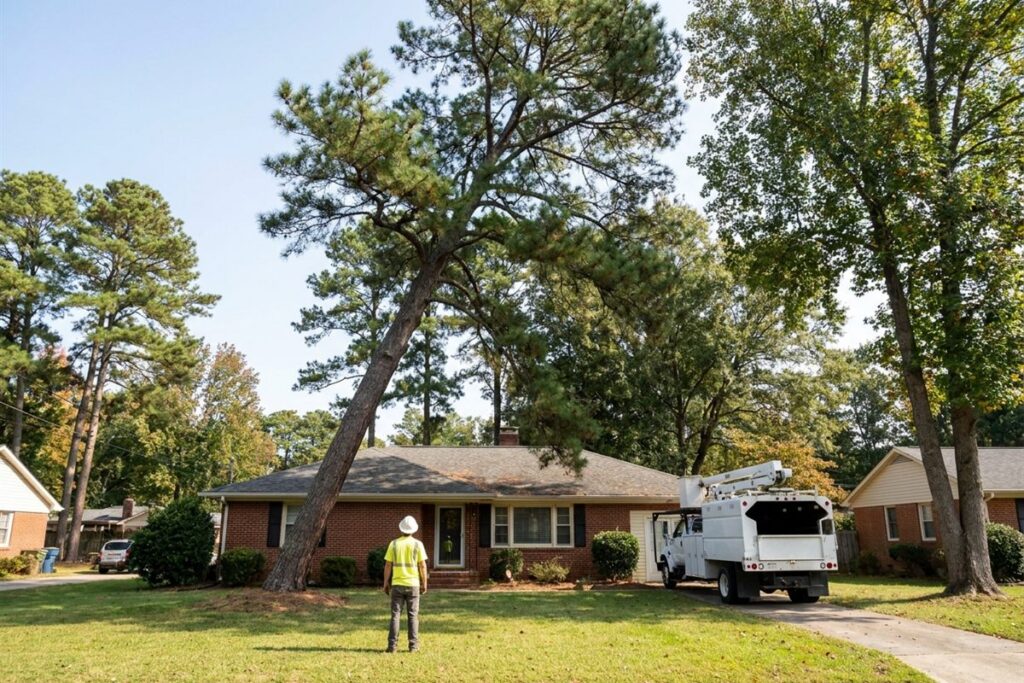
A leaning tree over open lawn and a leaning tree over your bedroom are two very different problems. Trees tend to fall in the direction they lean, so a lean aimed at the house, the driveway or a neighbor’s roof puts the target right in line. The good news is that most of these trees give some warning before they fail. A calm, sensible response in the first day makes the rest of the job far safer for everyone.
Step 1: Clear the Fall Zone
Assume the tree could come down at any moment and keep everyone out of the area it could reach. A rough rule is a distance equal to the full height of the tree, measured in the direction of the lean, plus a margin for limbs that bounce and roll. Move cars off the driveway, keep children and pets out of that side of the yard, and if the tree leans over a bedroom, sleep in another room until it has been assessed. Stay well clear of any lines the canopy is touching, because a tree resting against a power line can energize the ground around it.
Step 2: Check the Base From a Safe Distance
Look at the ground on the side of the trunk opposite the lean without walking onto it. Soil that is raised, cracked or split open, roots showing where there was lawn before, or a gap between trunk and soil all point to a moving root plate. Look up the trunk as well for fresh cracks, buckled bark on the leaning side, or large limbs now resting on the roof or gutters. Do not climb a ladder, cut anything, or tie ropes to the tree to try to hold it, since any of those can trigger the failure you are trying to prevent.
Step 3: Photograph and Mark the Lean
Take photos of the whole tree from two angles, plus close shots of the base and anything it is touching. A simple stake in the ground or a mark on a fence post lined up with the trunk lets you see whether the angle changes over the next hours or days. Those photos help us judge urgency when you call, and they are exactly what your insurance company will want if the tree damages the house. Note the date and the weather too, especially if the lean appeared after a storm.
Step 4: Call a Certified Arborist the Same Day
A tree leaning toward a house is not something to watch for a month. Call us at (984) 328-3971 and describe what you found at the base, and if the lean is fresh or getting worse we treat it as an emergency, day or night. For a lean that has clearly been stable for years, we will book a site visit and give you a free assessment of the roots, the trunk and the risk to the structure. Either way you get a straight answer from someone who has taken down leaning trees over Triangle homes for more than 30 years.
Step 5: Choose Removal, Correction or Monitoring
Once the tree has been assessed there are only three honest outcomes. A stable, compensated lean over open ground can often be left alone and rechecked after major storms, sometimes with pruning to lighten the side that carries the most weight. A small or young tree may be a candidate for staking and support while it roots in. A large tree with a failing root plate pointed at a building needs to come down under control, with rigging or a crane lowering the wood away from the roof rather than letting it fall where it wants to go.
Tree Leaning Toward Your Roof?
Book a free site visit and we will assess the root plate, the lean and what sits underneath it before anything else happens. We will tell you plainly whether it needs to come down or can safely stay. If the tree has moved since the last storm, call now instead, because our crews answer 24/7.
How to Straighten or Brace a Leaning Tree in the Triangle
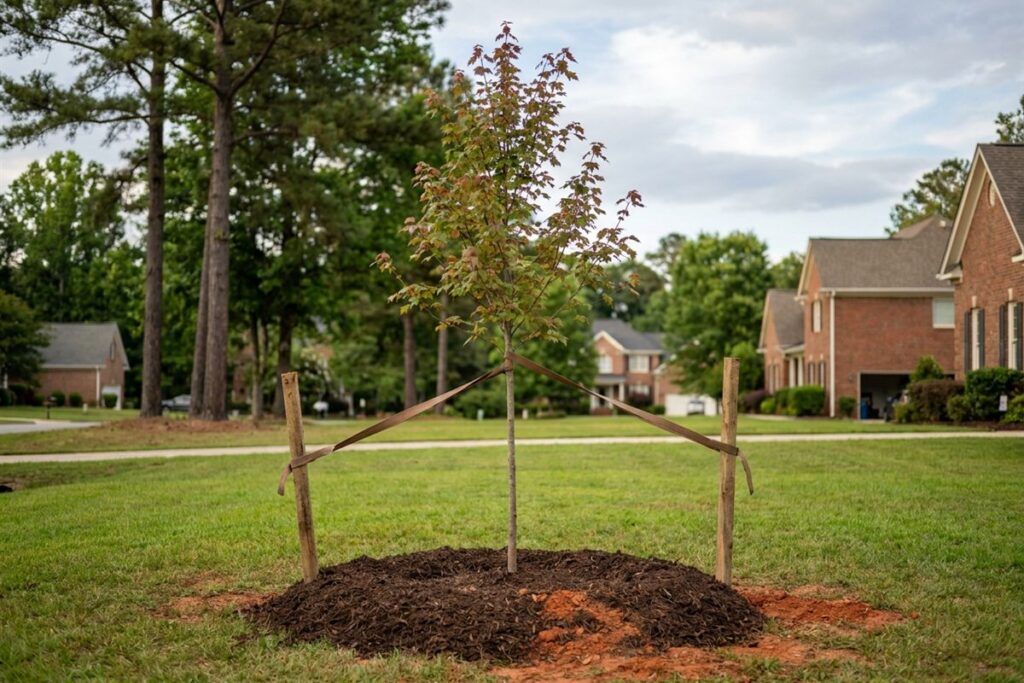
Pulling a leaning tree back upright sounds like the obvious fix, and on the right tree it works. Whether it is possible depends almost entirely on the size of the tree and the condition of its roots. A young tree with a small root ball can be straightened and supported while new roots grow, but a mature tree with a lifted root plate is a different matter. Trying the same approach on a 60-foot pine is how people end up hurt, or with a tree in the kitchen.
How to Straighten a Young Leaning Tree
Newly planted and young trees that have tipped in wet clay can usually be corrected if you act quickly, ideally within a day or two while the soil is still soft. NC State Extension advises straightening, replanting and staking small uprooted trees right away. Gently ease the tree upright, firm the soil around the root ball, and support it with stakes and wide, soft straps rather than wire or rope that cuts into the bark. Leave a little slack in the ties so the trunk can still flex, because that movement is what builds a stronger trunk and root system.
Staking a young leaning tree the right way:
- Wide, soft straps. Proper tree straps protect the bark where the tie makes contact.
- Stakes outside the root ball. Drive them into firm, undisturbed soil so they do not spear the roots.
- Some slack. The tree should be able to sway slightly in the wind rather than being held rigid.
- Regular checks. Loosen or remove ties before they begin to cut into a growing trunk.
- Fix the drainage. Redirect the downspout or low spot that softened the clay in the first place.
How to Brace a Large Leaning Tree
Large trees are a different story. Once a mature tree’s root plate has lifted and roots have torn, it is rarely practical to pull it back upright and anchor it, and winching a heavy trunk against broken roots can bring the whole tree over. Cabling and bracing systems installed by an arborist are designed to support weak unions between limbs within the canopy, not to hold up a trunk whose roots are failing. On a big tree, the honest answer is usually lightening the load with careful pruning where the roots are sound, or planned removal where they are not.
Why Cutting a Leaning Tree Is Not a DIY Job
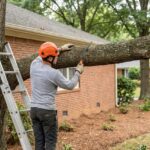
Videos make cutting down a leaning tree look straightforward, and it is one of the most dangerous jobs in tree work. A leaning trunk is loaded with tension on one side and compression on the other, so it can split upward without warning, a failure loggers call a barber chair, and throw the butt of the tree back at the person holding the saw. The tree also wants to fall in the direction of its lean, which is often exactly where the house is. That is why our crews take leaning trees apart from the top with climbers, a bucket truck or a crane rather than dropping them in one piece. A tree that lands on the roof during a DIY attempt turns a planned job into an emergency repair.
★★★★★
“I had a very large oak tree that was leaning on a terrible angle and growing closer to the house each year. I also had a bunch of overgrown fruit and nut trees that they pruned.”
Derrick B. · Verified Google Review
Dangerous Tree Removal in Raleigh, Knightdale and Garner: When It Is the Right Call
Removal is never our first answer for a healthy tree, but for a leaning tree it is sometimes the only safe one. NC State Extension recommends removing large, leaning trees and large wind-thrown trees that have been ripped from the ground, and that matches what we see in Wake County yards. A mature tree whose root plate has already moved in clay soil will not regrow its broken anchor roots before the next storm arrives. When that tree is pointed at a home, planned removal is almost always safer and less disruptive than waiting for it to fall.
Removal is usually the right call when:
- The lean is new or growing. It appeared suddenly or gets worse week by week.
- The soil has heaved. Ground is raised, cracked or split on the side opposite the lean.
- The roots are compromised. They are snapped, exposed or rotting at the base.
- The trunk is damaged. Cracks, cavities or fungal growth show near the ground.
- There is a target. The tree can reach the house, a garage, a driveway, a fence or a power line.
- The canopy took a beating. More than half of the crown was damaged in the same storm.
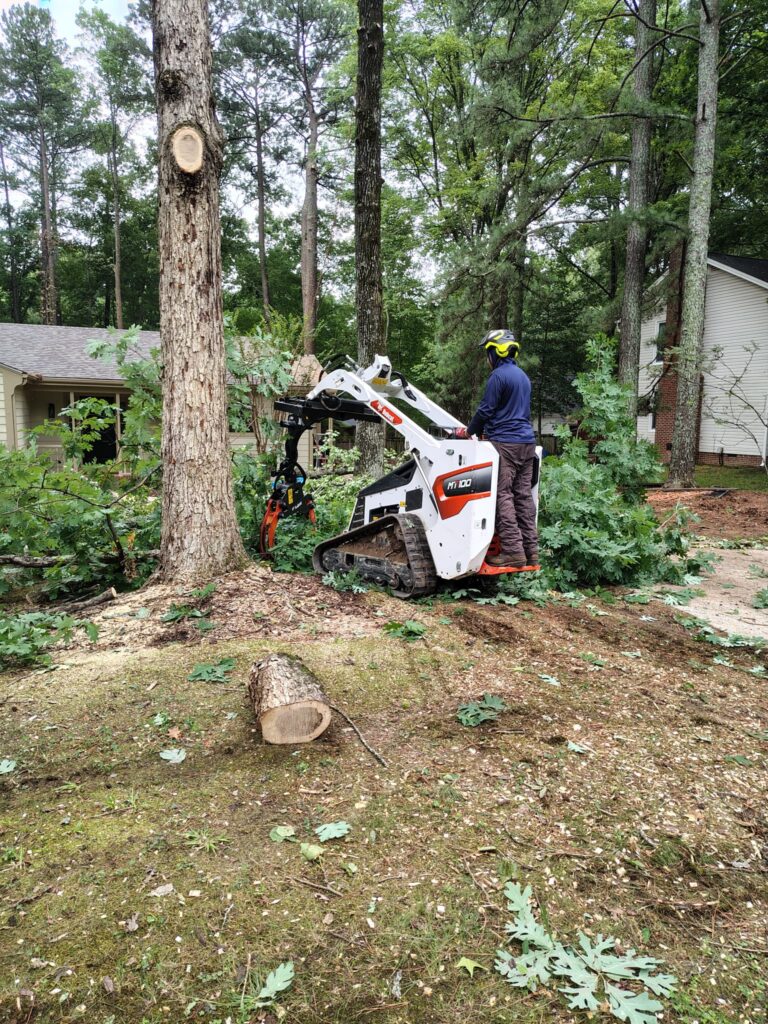
How we take a leaning tree down depends on what sits under it. Where there is clear space, our climbers and bucket truck remove the canopy in sections, using rigging to lower each piece on a controlled line so nothing swings into the roof. Where the tree leans directly over the house, a crane lifts whole sections clear of the structure, and a grapple saw lets us cut and hold each piece without putting a climber in a failing tree. On the ground our tracked loader and grapple move the heavy wood without rutting the lawn, and we leave your property looking better than it was when we arrived.
Leaning trees are a steady part of our work right across the Triangle. In eastern Wake County, our tree service in Knightdale regularly deals with tall pines on newer lots where grading has disturbed the clay around old root systems. South of the city, our Garner tree service crews handle the same wet-soil failures after summer thunderstorms and tropical rain. Whether the tree is in North Raleigh, Knightdale or Garner, the same certified arborist assesses it and the same safety rules apply.
Cost depends mainly on the height of the tree and what it leans over. Our published ranges run from $250 to $500 for trees under 30 feet, $500 to $1,200 for 30 to 60 feet, $1,200 to $1,900 for 60 to 80 feet, and $1,900 to $4,000 or more for trees over 80 feet or jobs that need a crane. Work over a house, fence or other structure where wood has to be hand-lowered typically adds $200 to $600 or more. Our tree removal cost calculator gives you a quick figure before we visit, and every site assessment is free.
Leaning Tree FAQs for Raleigh and Wake County Homeowners
When Should I Be Concerned About A Leaning Tree In Raleigh?
Be concerned when the lean is new, getting worse, or pointed at something it could damage. Raised or cracked soil on the side opposite the lean, exposed roots and trunk cracks all mean the root plate may be failing. In Raleigh’s clay those signs often show up after several days of heavy rain, so recheck your larger trees after every big storm.
Will A Leaning Tree Eventually Fall?
Not necessarily. A tree that has leaned the same way for decades has usually grown extra wood to support that angle and may stand for the rest of its natural life. A tree that has started leaning recently is far more likely to fall, because the lean usually means roots have broken or the soil has let go.
Does A Leaning Tree Need To Be Cut Down?
Only when the lean comes with other warning signs or the tree threatens something important. A stable, compensated lean over open ground can often stay with periodic checks and some pruning. A sudden lean, a heaved root plate, or a large tree leaning toward a house is usually a removal job.
How Do You Fix A Leaning Tree?
Young and newly planted trees can be eased upright, firmed in and staked with soft straps while the soil is still soft. Mature trees generally cannot be fixed that way, because pulling a heavy trunk against torn roots can bring the whole tree down. For large trees the practical options are pruning to reduce weight, regular monitoring, or removal.
How Do You Brace A Large Leaning Tree?
In most cases you should not try, and a homeowner should never winch or rope a large leaning trunk. Cabling and bracing installed by an arborist supports weak limb unions inside the canopy, not a tree whose roots are failing. If a large tree needs outside support to stay up, that is usually a sign it needs to come down under control.
Can I Cut Down A Leaning Tree Myself?
We strongly advise against it. A leaning trunk holds tension that can split it upward and kick the butt back toward the cutter, and the tree tends to fall toward whatever it leans over. Our crews use rigging, bucket trucks and cranes to take leaning trees apart piece by piece so nobody is standing in the line of fire.
Why Do Trees Start Leaning After Heavy Rain In Wake County?
Wake County’s red clay drains slowly, so days of rain leave it saturated and slippery. Saturated soil loses much of its grip on the roots while the canopy still catches the full force of the wind. That combination lets a storm rotate the root plate and tip a tree that stood straight the week before.
Does Homeowners Insurance Pay To Remove A Leaning Tree In North Carolina?
Policies vary, so read yours or ask your agent, but insurers generally respond when a covered storm actually brings a tree down onto a covered structure. Removing a standing tree before it falls is usually treated as the owner’s maintenance cost. Photographs taken as soon as you notice a new lean make any later claim much easier to support.
What Can I Do About A Neighbor’s Leaning Tree In Wake County?
Start with a friendly conversation and photographs of the lean and the base. If nothing changes, a dated written note describing the hazard puts your neighbor on record as knowing about it, which can matter if the tree later falls. An independent arborist assessment gives both of you a clear picture of the real risk before things escalate.
How Much Does Leaning Tree Removal Cost In Raleigh?
It depends mainly on the height of the tree and what it leans over. Our ranges run from $250 to $500 for trees under 30 feet up to $1,900 to $4,000 or more for trees over 80 feet or crane jobs, with $200 to $600 or more added for work over structures or hand-lowering. Every estimate is free and done on site.
I am Steve, and I own Ashland Tree Service. I have spent more than 30 years around Raleigh looking at leaning trees with worried homeowners, and the ones that concern me most are rarely the dramatic old curves, they are the straight trees that tipped a few degrees after a wet week. If a tree in your yard has started leaning toward your house, call me directly at (984) 328-3971 or book a free estimate, and I will come out, check the root plate with you, and tell you honestly whether it can stay. You have my promise that your family’s safety is our number one job, and we leave your property looking better than it was when we arrived.