
Is My Tree Dangerous? Free Tree Risk Checker for Raleigh Homeowners
Leaning tree, cracked trunk or a dead limb hanging over the driveway? Answer eight quick questions and find out whether your tree needs a call today, an inspection this week, or just a closer eye. If a tree is already on your house or a power line, call us now on 984-328-3971. We answer 24/7.
Tree Risk Checker: Is Your Leaning or Damaged Tree Dangerous?
Walk around the tree first and look at it from a few sides. Then pick the answer that fits best for each question. It takes about a minute.
Leaning Tree Warning Signs Raleigh Homeowners Should Not Ignore
Plenty of healthy trees grow with a lean. A tree that has leaned the same way for twenty years has usually built extra wood on its underside to hold itself up. The lean on its own is rarely the problem. The problem is a lean that is new, or one that is getting worse.
Wake County sits on heavy red clay. After days of rain, that clay gets saturated and soft, and a tall tree with a big crown can start to rock its root plate loose. That is why so many trees come down here during tropical storms, when wind arrives on top of soaked ground. Pines are especially prone to it, and we explain why in our guide to why loblolly pines fall in Raleigh.
Signs a Leaning Tree Is Dangerous
Signs a Tree Is Going to Fall
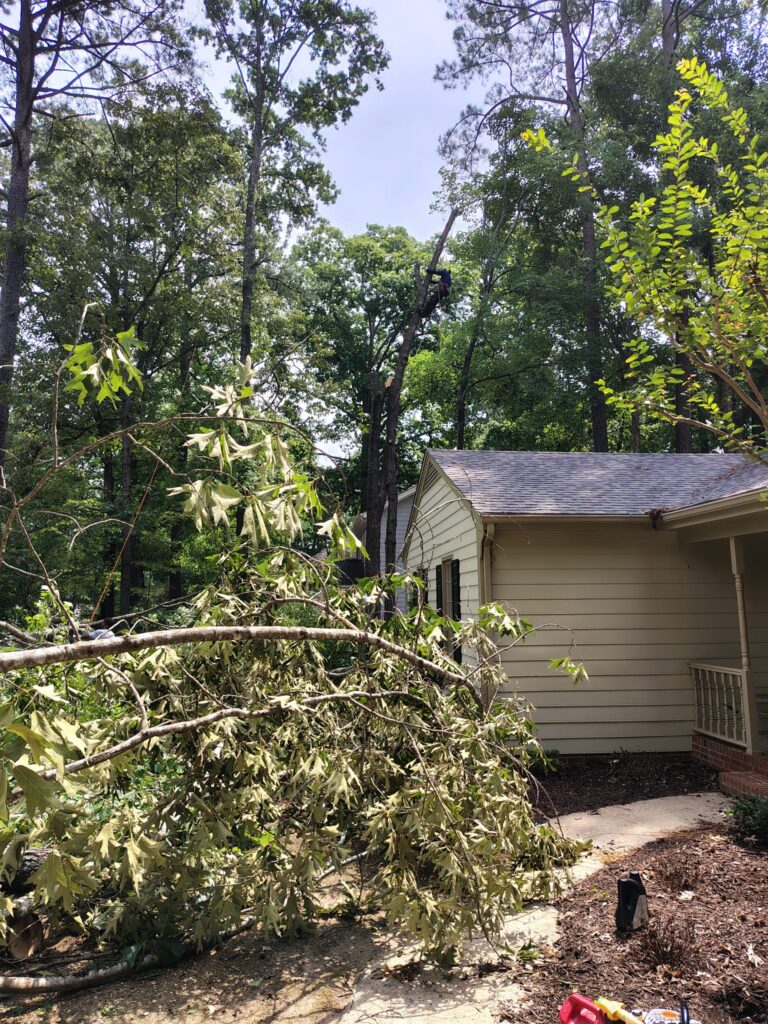
Trees rarely fall without giving some warning first. These are the signs we see most often before a tree comes down in a Raleigh yard:
- Cracks in the trunk. A vertical crack, or a split where two main trunks meet in a tight V, can open up under wind load.
- Mushrooms at the base. Fungus growing from the root flare often means the roots holding the tree up are rotting from the inside.
- A thinning or dead crown. Bare branches at the top of an oak, or needles turning brown on a pine, point to a tree in decline. Our guide on how to tell if a tree is dead walks through the checks.
- Hanging limbs. Broken branches caught in the canopy can drop at any time, usually on the next windy day.
- Bark falling away. Large patches of bark peeling off with bare wood underneath is a sign that part of the tree has died.
One sign on its own does not mean a tree has to come down. Two or three together, on a tree close to your house, is when we recommend an inspection. Many trees can be made safe with the right tree pruning rather than removal.
Tree Limbs on Power Lines: What to Do
If a tree or branch is touching a power line, treat the line as live. Keep everyone at least 30 feet away, do not try to pull the branch off, and call your power company first so the line can be made safe. Once the utility has cleared the line, we can remove the rest of the tree and clean up the yard. If the tree is also resting on your house, call us straight away and we will help you work out the order of calls.
Dangerous Tree Removal in Raleigh and the Triangle
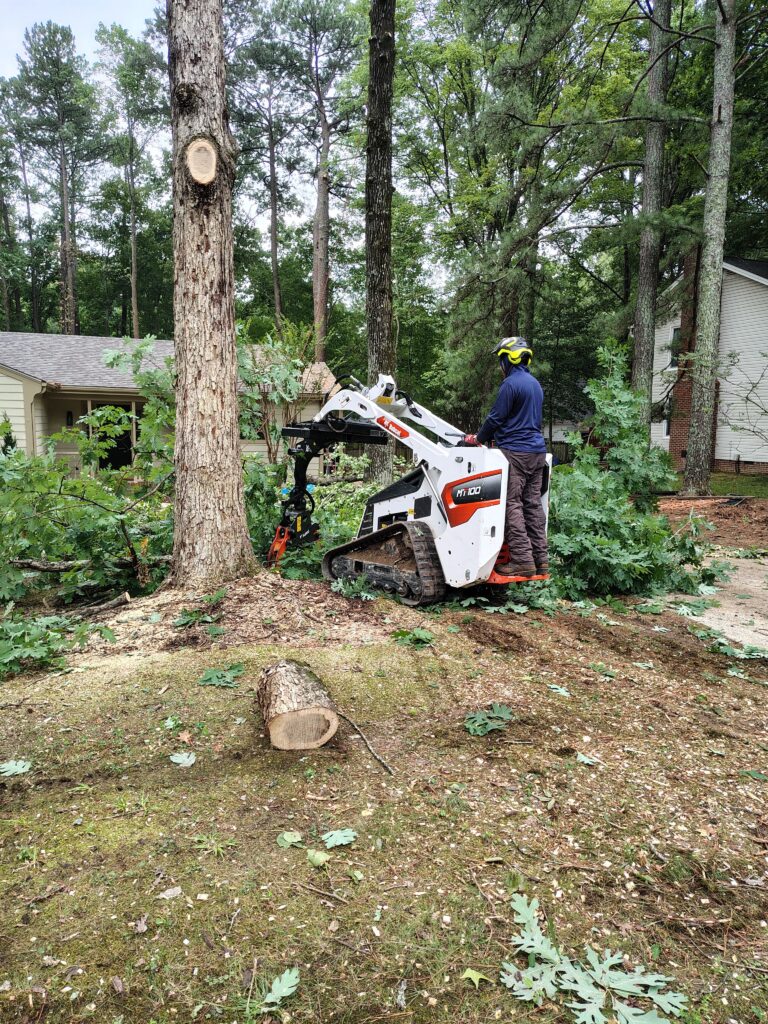
When a tree is too risky to keep, we take it down in controlled sections instead of dropping it in one piece, so nothing lands on your roof, fence or cars. Big trees over houses may need a crane, which we cover in our guide to crane-assisted tree removal. We handle dangerous tree removal across Raleigh and in Cary, Garner, Knightdale, Wake Forest, Apex and Durham. Wondering what it might cost? Try our tree removal cost calculator.
What Happens at a Free Tree Risk Inspection
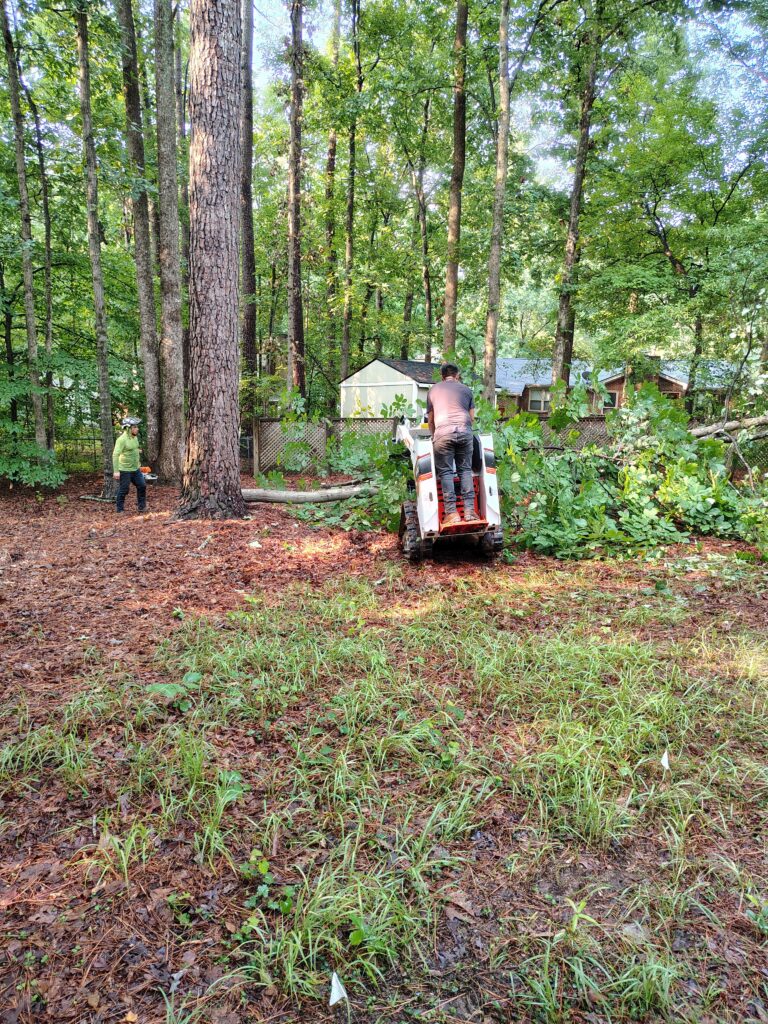
- Step 1: We walk the tree with you. Steve looks at the lean, the root flare, the trunk and the crown, and asks what has changed.
- Step 2: We check what it could hit. The same defect means something very different over a roof than over an empty back lot.
- Step 3: You get a straight answer. Keep it, prune it, or remove it, with a written price if work is needed. No pressure either way.
Dangerous and Leaning Tree FAQs
Is a leaning tree dangerous?
Not always. A tree that has leaned the same way for years is usually stable. A leaning tree becomes dangerous when the lean is new or getting worse, when the soil is cracking or lifting at the base, or when it leans toward your house or a power line. Use the tree risk checker above, or book a free inspection.
How can you tell if a tree is going to fall?
Look for cracks in the trunk, mushrooms at the base, lifting roots, a lean that has changed, hanging branches and a thinning crown. Two or more of these together on a tree near your home is a good reason to get it checked. Our guide on how to tell if a tree is dead covers the signs in more detail.
What should I do if a tree is leaning on my house?
Get everyone out of the rooms under the tree, keep away from any power lines, and call us on 984-328-3971. Do not try to cut or pull the tree yourself, because the weight can shift suddenly. Take photos for your insurer if it is safe to do so. We run 24/7 emergency tree service across Raleigh.
Can a leaning tree be straightened?
Young trees planted in the last year or two can sometimes be staked and straightened. Mature trees cannot. Trying to pull a large tree upright can break roots and make it less stable. For an established tree, the choices are usually to reduce weight with tree trimming, or to remove it if the lean is a risk.
Will insurance help me remove a dangerous tree?
Homeowners policies usually pay when a tree has already damaged a covered structure, and less often for removing a tree before it falls. Every policy is different, so check yours. If the dangerous tree belongs to a neighbor, read who pays when a tree falls on a neighbor’s house in North Carolina.
What can I do if my neighbor has a dangerous tree?
Start with a friendly conversation and share what you have noticed. It helps to put your concern in writing and keep photos. An arborist’s opinion can also help your neighbor see the risk clearly. Our article on tree liability in North Carolina explains why that written notice matters.
How much does it cost to remove a dangerous tree?
It depends mostly on the tree’s height and how close it is to your house or other structures. Our tree removal cost calculator gives you a local price range in under a minute, and our estimates on site are always free.